Robert Van Buren Ricks (1837-1887)
My Paternal 2nd Great Grandfather, married Winifred Louise Leggett

Robert Van Buren Ricks, the son of Thomas Little Ricks and Sarah Ann Latham, was born in 1837 in Beaufort County, North Carolina. Robert is my 2nd great grandfather. It’s very possible he was named for President Van Buren who took office in 1836. It would have been a controversial choice as New York born Van Buren won only 50.7% of the southern vote. His Vice President, Richard Johnson, was involved in an unpopular open relationship with an enslaved women whom he regarded as his common-law wife. And although Van Buren personally owned enslaved persons, he opposed the expansion of slavery into new western territories. Within months after his inauguration the Panic of 1837 devastated cotton prices and many southerners blamed Northern bankers and by extension Van Buren’s administration. His refusal to use federal funds to rescue banks led to his nickname “Martin Van Ruin”, which cost him his chances for re-election At that point Robert’s parents may have regretted their choice of Robert’s middle name.
[Painting: President Martin Van Buren]
At age 24 in February of 1861 Robert married Winifred Louise Leggett, the daughter farmer Blount Leggett and Arietta Wynn. The couple settled down to farming life together in Tranter’s Creek, Beaufort County, North Carolina where their families both lived.
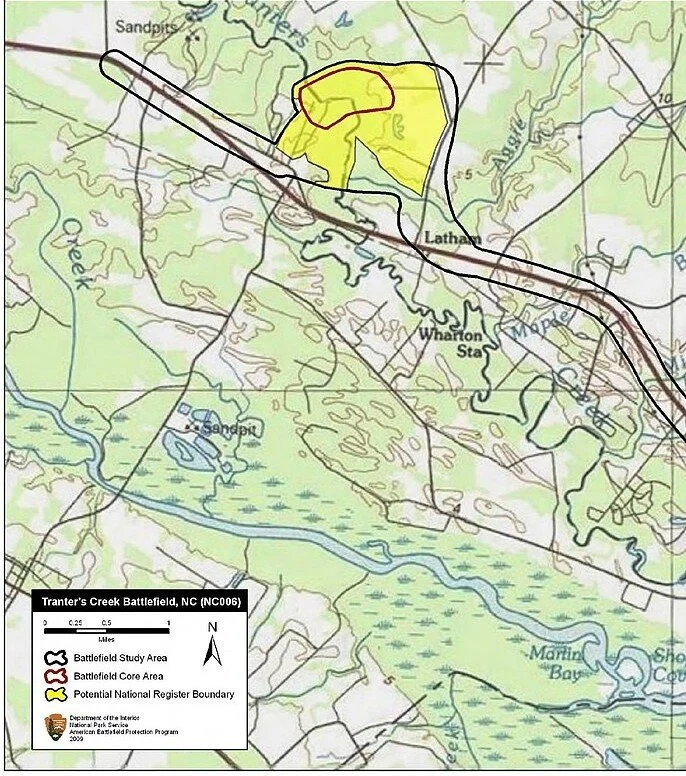
Winifred was seven months pregnant when Robert enlisted in the Confederate 55th North Carolina Infantry as a private on May 30,1862. With precious little time to train the troops, five days later on June 5, 1862 Union forces advanced to Tranter’s Creek and a battle commenced. Five hundred Union soldiers faced off against an equal number of Confederates. Blood was shed on both sides of Myer’s Bridge which spanned the creek. The Confederate forces, led by Col. Singletary, were barricaded in a mill. After a heavy artillery bombardment by the Union’s artillery, Singletary was killed and the Confederates retreated. In close proximity to the battle (the red circle inside the yellow area on the map), is a village called Latham, which very likely was named after Robert’s mother’s family.
A month after the battle was over, Winifred gave birth to their first born child, Robert Montford Ricks, in July of 1862.
[Photo: A Map of the Tranter’s Creek Battlefield 1862]
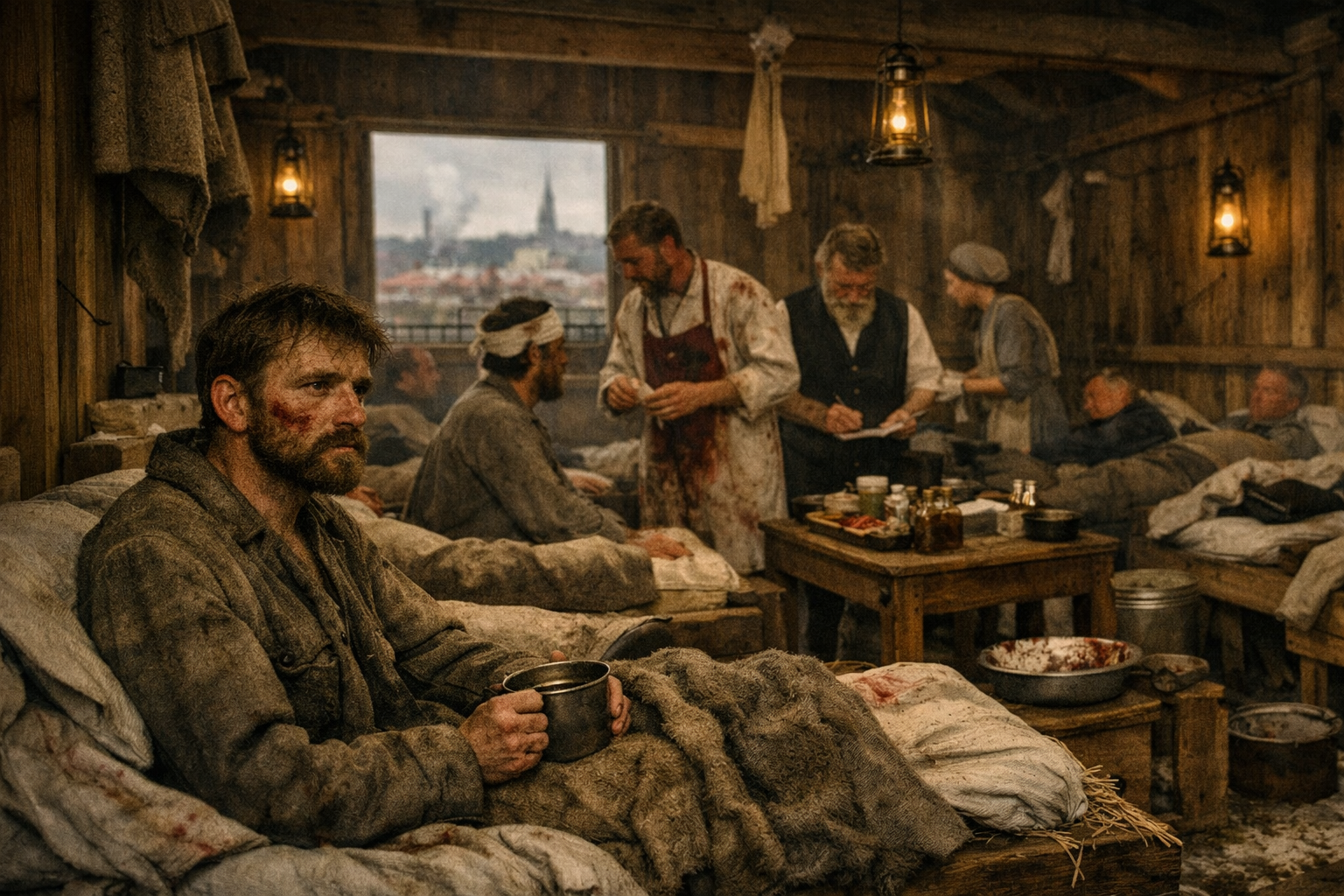
The rest of 1862 until February of 1863 was a relatively quiet time for the 55th Infantry. They served in rear-area posts not front line combat zones. During this period units rotated men home regularly so they could help plant and harvest crops to help with food shortages. It was a period of calm before the proverbial storm. In the late spring of 1863 the 55th Infantry engaged in the shoring up defensive lines of Richmond Virginia. Robert was involved in picket duty, scouting and skirmishes with Union Calvary during which he suffered an injury. He was hospitalized in Richmond Virginia on June 4, 1863. Nineteen days later, he was released in time in time to join his brigade for their assault on Gettysburg.
[Image: AI generated image of Robert recovering from his injuries in Richmond Hospital in 1863]
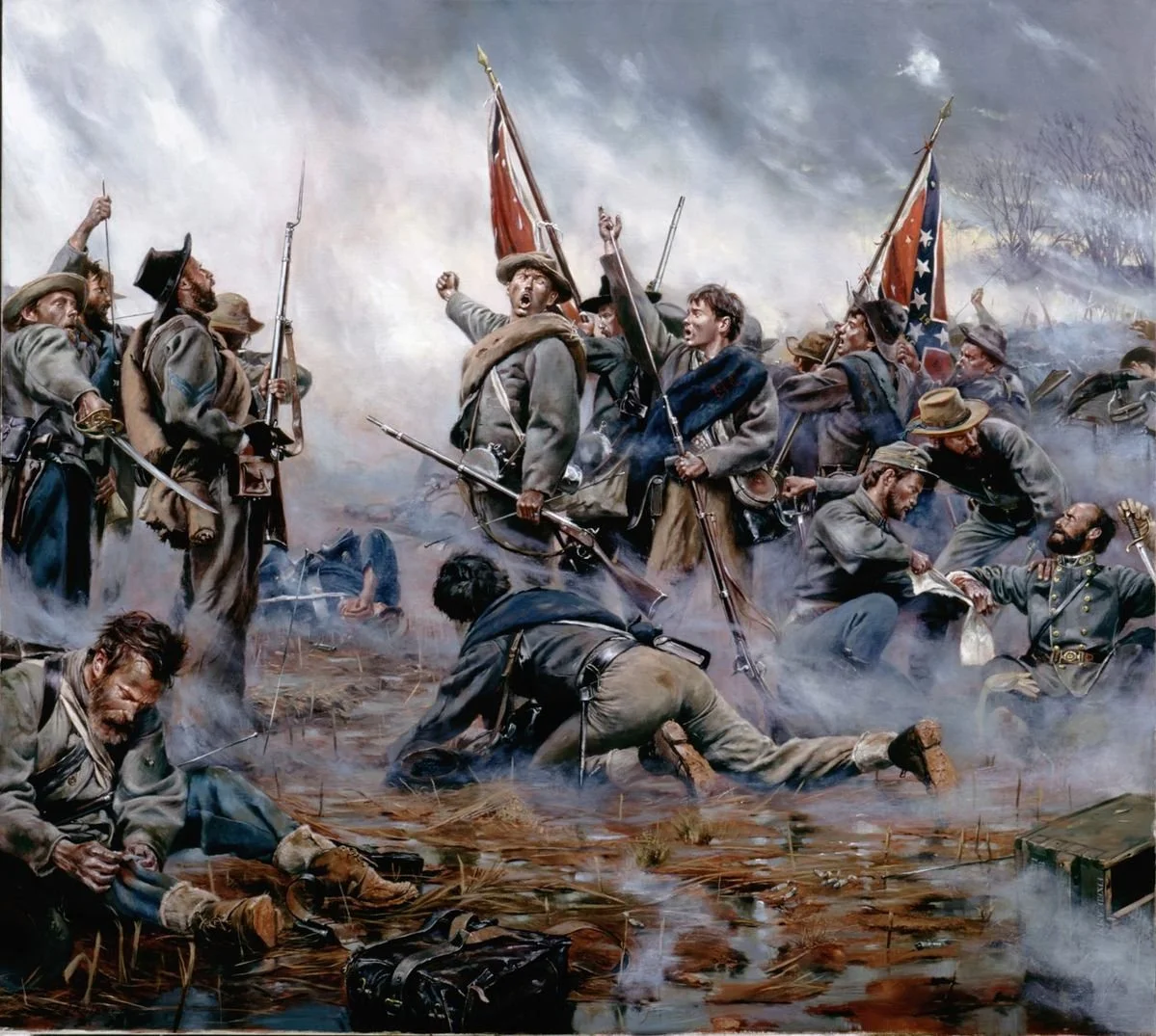
A regiment is normally composed of 10 companies of 100 men each for a total of 1,000 men. When the 55th infantry entered the field at Gettysburg there were only 640 men present for duty. In the first year alone regiments lost 20 to 30% of their men to typhoid, dysentery, pneumonia, measles and malaria. Some soldiers had deserted. Others were not present due to medical leave. Others were assigned to non-combat duties cooks, couriers, guards and the like. Robert and 640 other brave souls entered the blood bath at Gettysburg and suffered a casualty rate of 31%. By the time the war ended in at Appomattox Courthouse only 81 men from the 55th Infantry remained.
[Painting: Civil War Bonnie Blue Flag by Don Trioiana ]
After Gettysburg Robert was promoted to Corporal and his regiment participated in the Overland Campaign, facing off against General Ulysses S Grant who was relentlessly marching his combat troops toward Richmond Virginia. At Talley’s Mill in Virginia, forty miles northwest of the city, Robert suffered a gunshot wound to his face, was captured in the field and became a POW.
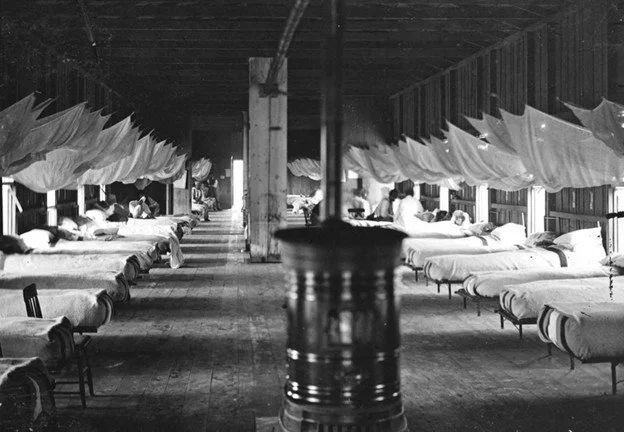
He was sent on a military “steamer,” a transport ship converted into a floating hospital with other prisoners to Harewood Hospital in Washington DC which had a special unit just for facial wounds. The hospital steamer and the ward became islands of humanity – places where compassion briefly outweighed politics. Accounts from Richmond’s hospitals describe Confederate nurses weeping over Union boys who reminded them of their own sons — and Union nurses doing the same for Southerners. Once stable, James was escorted under guard to Old Capitol Prison, the holding site for interrogation and processing.
[Photo: Image of peaceful Harewood Hospital taken before the barrage of patients arrived.]
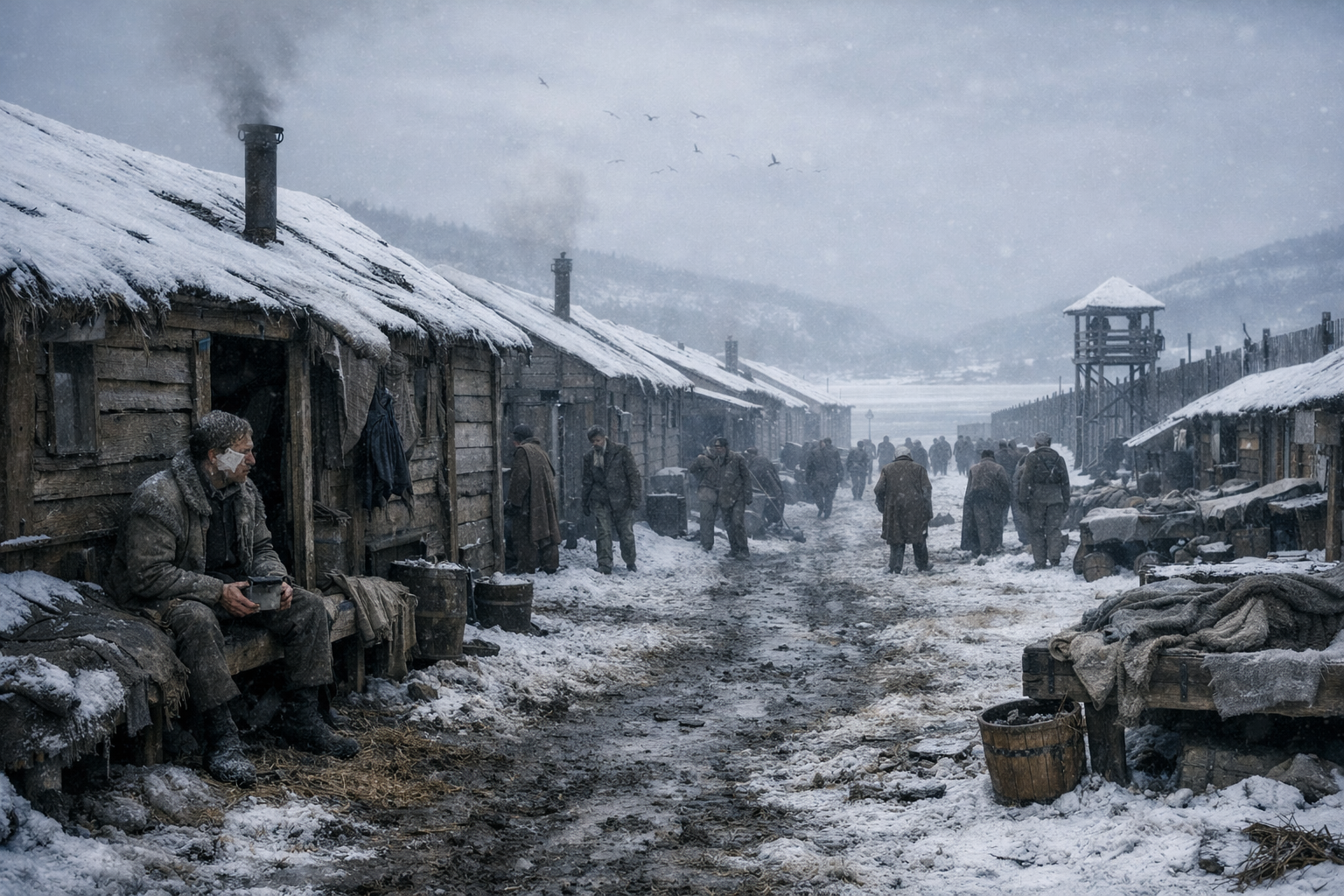
From there he was transferred to the horrific Elmira POW Camp (aka “Hellmira”) in New York where nearly 25% of the prisoners died from disease and malnutrition. Here the compassion ended. Surviving Elmira was no small feat. Many prisoners died within months. The prison was overcrowded, the winters were harsh, the food and shelter inadequate, sanitary conditions horrendous and there were constant disease outbreaks. A despicable heartless man named Nichols built a three story observation tower and charged 15 cents per view so the curious public could get a view of the imprisoned soldiers. Nichols reportedly made $5,000 before the commandant ordered the tower to be taken down.
[Image: AI generated image of Elmira POW camp in winter.]
Robert endured nearly a year at Elmira, a tribute to his physical and mental resilience. In April 1865, near the end of the war, Robert was exchanged and released. He returned to North Carolina physically scarred but alive—having survived two wounds, two imprisonments, and one of the deadliest POW camps of the war. After the war, Robert resumed civilian life. Like many Confederate veterans, he returned to farming and his family, rebuilding his life in a devastated region. Five years after the war in the 1870 census his real estate and personal property were valued at a modest amount - $300. When he returned home from the war, Robert and his wife Winifred had nine more children, one of whom, Thomas Blount Ricks Sr is my great grandfather. Robert Van Buren died in Beaufort County at the age of 52 in 1887.
