The Bland Family
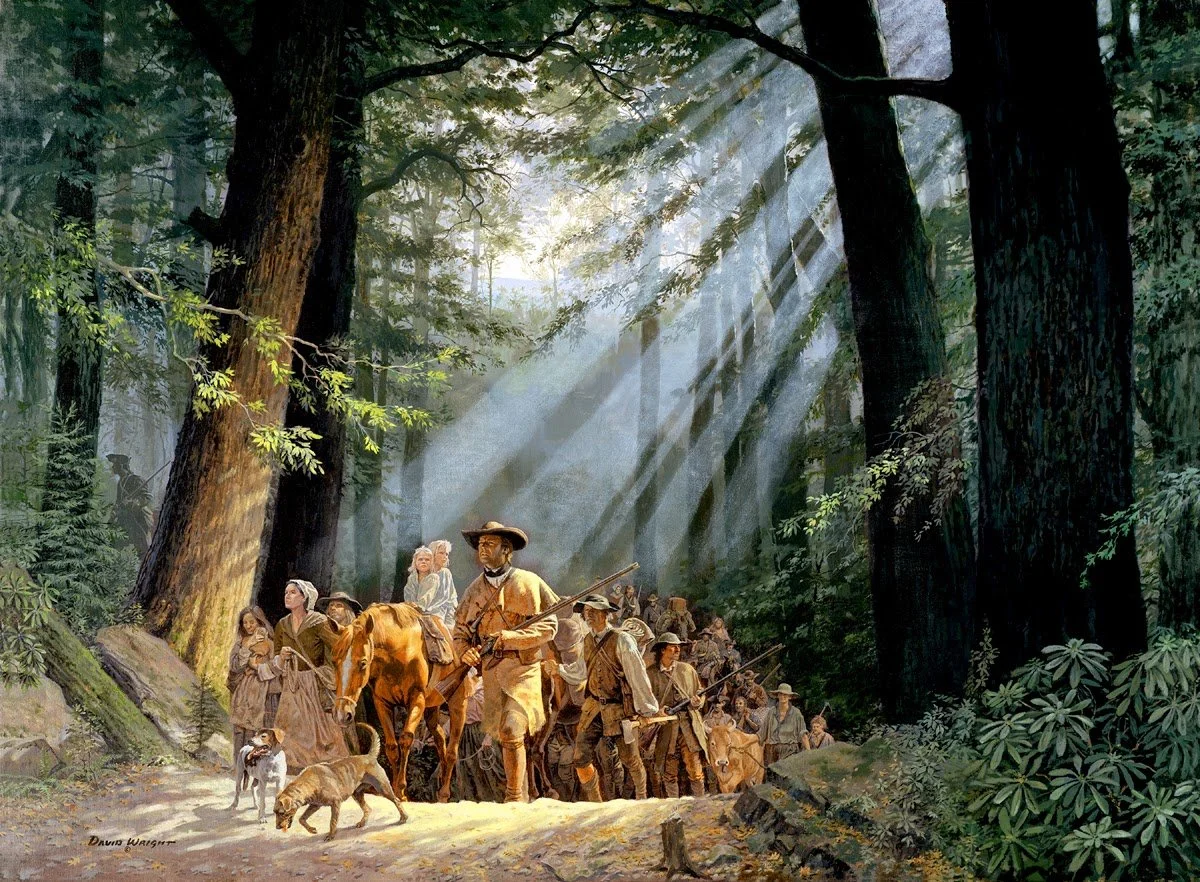
In 1775 Daniel Boone lead a group of settlers through the Cumberland Gap in the Appalachian Mountains opening the way for others to migrate to Kentucky and beyond. And so began the growing tension between the Native Americans and the white settlers in that area.
Three generations of the Bland family left Virginia in the winter of 1781 and made the harrowing journey through the Cumberland Pass in Virginia and into Kentucky to start a new life. What started as small isolated ambushes culminated in a full out assault on the Kinchloe Station on September of 1782. The story that follows has been passed done through generations and undoubtedly embellished over the years but without question whatever happened that terrible day left an indelible mark on the Bland family.
[Photo: Painting of Daniel Boone leading group of settlers through the Cumberland Gap]

Painting of Native Americans in Battle Charge
It is said the Shawnee swarmed around the station between midnight and daybreak, broke down the gates, and forced their way into the fort's interior. All of the terrified inhabitants were overpowered, killed or captured. Present inside the fort was Osborne Bland (my 5th Great grandfather), his wife Lettice Bland and two of their children, as well as some of their relatives. Osborne’s cousin, Thompson Randolph, fought desperately in hand-to-hand combat to protect his family. His wife was killed along with their baby. Thompson retreated with another child where they eluded detection, in a hayloft that miraculously managed to escape the Shawnee's torch. Osborne’s four year old son Jesse was captured and dragged away to an unknown future and their infant was brutally killed before their eyes. Osborne allegedly ran out of ammunition, took his empty rifle and bashed several Indians with it. He and his wife were captured and both were condemned to be burned alive.

Osborne was bound and Lettice was stripped naked and left to walk free beside him. As they began the long march to the a village to meet their terrible fate, Osborne urged Lettice to break away and leave him when she could. The opportunity came at night while the Indians were sleeping. Lettice crept away and her departure was not noticed until the Shawnee awakened the next day. Meanwhile, Lettice, who had been walking in circles, had not gone far from her tormentors. Fearing discovery, she climbed into a hollow log and concealed herself well enough that the Shawnee passed by her. Lettice tried to walk back to the fort, but again walked in circles and ended up the first day of freedom back at the hollow log where she slept until she was chased out by a bear.
She wandered in the wilderness for seventeen days, eating "sour grapes and green walnuts," until she finally made her way back to Kinchloe's station. Arriving at the burnt station's walls, her gaunt and nude body gave out and she fell into a dead faint. Fortunately, a passing huntsman found Lettice and carried her to nearby Lynn's Station, where she was nursed back to health.
[Photo: Black Bear in the Appalachians]
Osborne somehow managed to get a reprieve from his death sentence and after three years in captivity he was taken to Canada where he was sold to a Frenchman and returned to Kentucky. His son Jesse was reared by the Indians until many years later when he when he was also sold back to whites. He was recognized by his family by a scar on his body. Against all odds, Osborne and his wife and their children were reunited. Osborne and Lettice did not have any children after their ordeal but it has been speculated that she was brutally raped and possibly rendered sterile. Their son Jesse recovered from his ordeal, married, became a minister and moved to Arkansas where he established a Baptist church. He was nicknamed “Old Hardsides” for the force with which he preached.
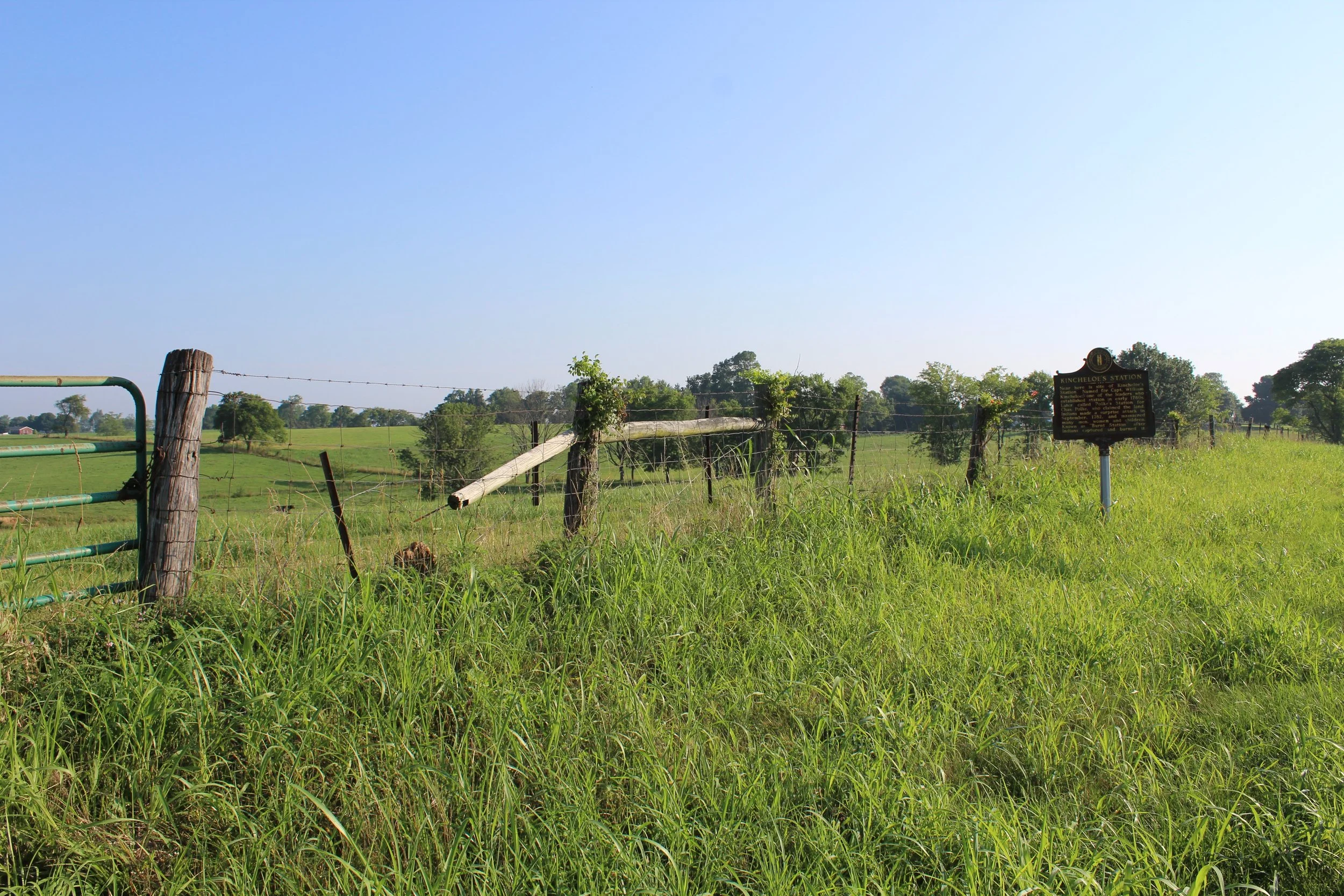
[Photo: Area where Kinchloe Station was burned to the ground with Historical Marker shown on right]
Four of their children were not present at the Kinchloe’s Station when the Massacre occurred: twelve year old Margaret, ten year old Sarah, eight year old Osborne Jr and six year old Elam. In 1786 four years after the attack, sixteen year old Margaret married William Phillips. (Their daughter Mary Philips later married Edmund Rutter Rodgers, my Grandma Rosa Rodgers’ great grandfather.) In 1790 eighteen year old Sarah married James Willett and disappeared into obscurity. Nothing has been uncovered about Elam. In contrast, much has been written about Osborne Jr, my 4th Great-Grand Uncle.
Osborne Jr. had a difficult life. He married Patsy Donahoo in 1799 and the family moved to Indiana. Their children were hellions and made quite a notorious name for themselves by engaging in various shootings, adulteries, drunken raucous fist fights and in the case of their son, Hiram, murder most foul. Patsy died in 1847. Shortly thereafter, on December 15, 1848 Osborne married Sarah Kent Andrews, a gold digger that was 25 years younger than he was, who wanted the pension she mistakenly thought he had. On February 1, 1849 her son Isaac beat poor Osborne to death with a fence post. At the trial Isaac claimed that Osborne died of "old age, drunkenness, exposure to cold and falling from his horse."
Sarah Kent’s first marriage was to a man named Alexander Andrews in 1814. After he died in 1839 Sarah had tried unsuccessfully for many years to secure a pension based on Alexander’s 1814 war service. (The War of 1812 was over three months after he enlisted.) After Osborne was brutally killed, Sarah dropped the name Bland and pretended her second marriage never happened. She went back to her former husband’s name, and applied again for his pension. She was very persistent – I found a copy of an application as late as 1899. She died in 1890 at the age of 99. Her obituary said she must had great endurance to “withstand the attacks of the enemies of life and the burdens that had been cast upon her.”
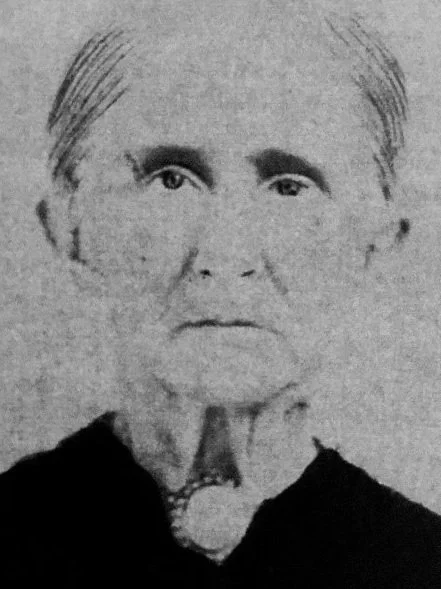
[Photo: Sarah Andrews Bland, Osborne Bland Jr’s 2nd wife]

In 1851 not long after the beating death of his father Osborne Jr, 25 year old Hiram was charged with the murder of his brother-in-law William Walker. Walker was married to Hiram’s sister, Lettice. Walker objected to the cruel treatment that Hiram gave to Lettice. There were two versions of the story presented at trial. In one version Hiram climbed over the fence where Walker was tending his tobacco, drew his knife, shouted “I have come to kill you, you #%&*!” and stabbed him. In the other version Walker’s wife, Lettice, testified Walker had chased Hiram with a stick and in self-defense Hiram turned and stabbed him. In both versions Hiram was “drunk as a coot.”
The jury was quick to return a verdict of guilty and sentenced Hiram to be hung by the neck until dead. A contributing factor in calling for the death penalty was Hiram’s bad reputation. Hiram and several of his brothers were powerful men physically, and when drinking were excessively quarrelsome, and viewed as extremely dangerous.
[Photo: Hangman’s Noose]
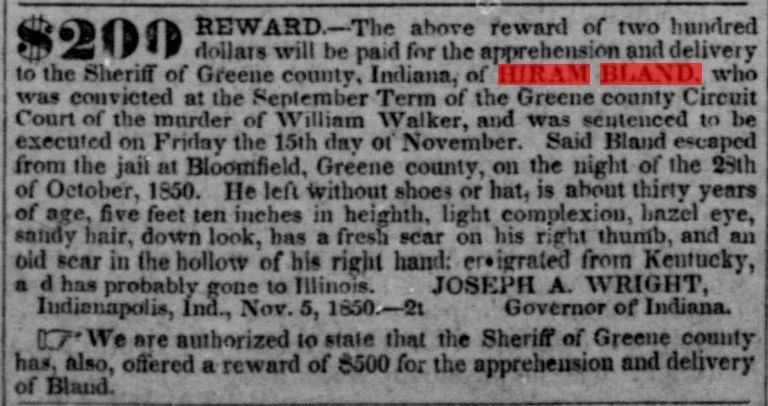
Two weeks before his scheduled execution Hiram escaped from jail and it took the authorities two months to find him, based on a tip from one of his “friends” who betrayed him “for the price of a new saddle”. Hiram was recaptured and swung from the gallows for his deed on June 13, 1851. The Sheriff who conducted the execution said Hiram conducted himself in an exemplary manner. After the hanging, the gallows were left standing until it rotted into decay.
[Photo: Reward posted for capture of escaped convict, Hiram Bland]
Murder and mayhem were not limited to the Osborne Bland limb of the family tree. Osborn Bland Sr and Charles Bland shared a common Great Grandfather – James Bland who immigrated to Virginia from England in 1684. Charles Bland (1765-1842) married Phyllis Pope who dutifully gave birth to fifteen babies. Stay with me, this gets better. Charles and Phyllis had a daughter, Prudence Bland, who married Robert Austin. Their son George Austin had a son, Will, who was so unruly and so unmanageable that his family threw him out of the house. Prudence’s sister Bessie felt sorry for her grandnephew and invited him to stay with her in the house she had inherited from her father Charles. Having no place else to go, Will moved in with her. Bessie would come to regret her invitation.

One evening on the 20th of January of 1882, in a drunken stupor, consumed with anger (which had nothing to do with his Aunt Bessie) 25 year old Will grabbed the axe from the wood shed and hacked his poor 80 year old Aunt to death as she knitted quite innocently in her living room. In addition to the deep gashes from the axe, her face bore the marks of a boot heel. When Will was apprehended her grey hairs still clung to his boot and he had blood on his clothes. He claimed he had been out hunting rabbit.
[Photo: Axe for chopping wood]
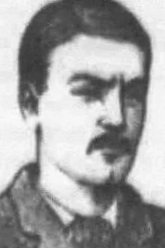
Will was hanged for his gruesome, senseless crime on October 13, 1882 and it turned out to be a gala event. Residents whose homes had a view of the gallows charged scalping tickets (50 cents to $1.50) at higher prices than the official ones offered by the sheriff. Will proclaimed his innocence until one hour before his execution. He claimed “whiskey made me do it” and that he “loved Bessie like a mother.” He went on to say, “I offer myself a willing sacrifice on the gallows for the deed. I will die happy believing that the vilest sinner can be forgiven if he truly repents. I believe God has given me a full pardon. I believe my aunt was a Christian and I will met her in heaven.” I doubt Aunt Bessie would share his sentiments.
[Photo: Will Austin, from newspaper clipping]
Will walked to the gallows and smiled, seemingly fearless. The newspaper reporting attributed this either to his “total incomprehensive of what was happening or to his bull dog courage which he was anxious to display to his admiring crowd.” They say that at his ultimate moment of truth, as the noose slipped around his neck, Will turned to the hang man and said ironically, "You are choking me." In front of 3,000 spectators craning their necks to see, Will fell through the trap on the gallows and hung for 20 minutes before life completely left his body. The news headlines that day read:
WILLIAM AUSTIN EXPIATES HIS CRIME
After Making a Confession of his Cruel Murder,
And Exhorts Against Whiskey Drinking and Evil Companions
The Calmest Man Ever Met an Ignoble Death
Two days before Will took an axe to his great aunt Bessie another tragic senseless murder took place in Garrard County Kentucky. The Wilmot family lived not far from the Bland farm and the two families were connected. James R. Wilmot and his wife, Elizabeth had at least seven children. By 1882, James’ mother, also named Elizabeth, had moved into the household and all but four of their offspring had moved into their own homes.
At 5 AM on the 18th of January, 1882, Alice Calvin, a servant of the Wilmot home, came downstairs to see James leaving his mother’s room. She asked him what was the matter and he replied that he had killed his family and would kill himself. He did not threaten her in any way. Seeing the youngest son Benjamin alive, Miss Calvin took hold of the boy and they ran to the home of Mr. Enoch Parks, a neighbor that lived close by.
The Wilmot’s twenty-year-old son, James Jr, heard the noises and came to see the cause. He met his father downstairs and James told his son that he had killed the family and would kill him too. There was a struggle, but the son overpowered the father just enough to get free of his grasp. James Jr ran for help. James Sr wrapped a plow-line around his neck and to a beam in the shed and jumped, hanging himself. The acting coroner, Squire Boyle, found James Sr hanging in nothing but his night shirt and drawers. Inside Boyle found the bludgeoned bodies of James’ wife Elizabeth, their two daughters Martha Susan age twenty-two, and Mary age thirteen, and his eighty-seven year old mother. All murdered by James Sr with the same axe. The local newspaper described the event as follows:
Garrard County Farmer Kills His Wife, Mother and Two Daughters
With An Ax, and Then Swings Off Into Hades at a Rope's End.
Day before yesterday he talked rather strangely to his family, saying the stock was all going to die, and himself and family also, of starvation. Two or three times in the last few days he expressed a fear of death from starvation, and acting under this hallucination, it is believed that he arose from his bed this morning, took the ax and with a single stroke to each of his daughters struck them dead in in their beds, they never knowing from whence the blows came. His wife, [n]o doubt, was awakened, and getting out of bed doubtless attempted to restrain him, but was knocked down and terribly mutilated. He then went into the adjoining room and, there raising the bloody ax on high, sunk it deeply into the breast that had nurtured him in infancy, taking away from her that she had given him -- life. Happily that aged and devoted mother never awoke to realize from whom the cruel blow came.
James R. Wilmot, the man who, by his insane act, sent four of his nearest and dearest kin on earth to their eternal home, was about sixty years old, a farmer by occupation. He was an honest, close, economical business man, and had owned a farm of about 250 acres, on which he lived. He was in good circumstances -- being worth $8,000 or $10,000 -- and it seems strange that he should have become so worried over a small debt of $400. He was kind and affectionate to his family, and to his old mother he was the most devoted of sons. It is supposed that with the hallucination in his mind that all his family were to die with starvation he resolved to murder them and kill himself to avoid that fate.

Elizabeth Lear Wilmot, the mother who was murdered by her own son on that terrible night, was James Sr’s father’s second wife. His father, Erasmus Wilmot, had been previously married to Sally Bland …. wait for this, folks…..Sally Bland Wilmot was buried in the same cemetery as another axe victim - her sister, Bessie Bland. As Paul Harvey was known for saying, “And now you know…… the rest of the story.”
May they all rest in peace.
