The Baum and Eldridge Family
On July 22, 1587, an intrepid group of 118 English men, women and children led by John White set foot on the shores of an island (present day Roanoke Island in North Carolina). One can easily argue it was a fool’s mission. The previous settlement attempts in this area had failed despite being comprised of armed soldiers. All that remained of the military colony of 1585 was a sun bleached skeleton of one of the men. The 1587 group of colonists were primarily middle class Londoners, most likely seeking to become landowners and their leader White, a cartologist and artist, was there to document people, fauna and flora. Not exactly a prescription for success. Shortly after arriving, White’s daughter Eleanor gave birth to the first English child born in North America, Virginia Dare. It seemed like an auspicious beginning.
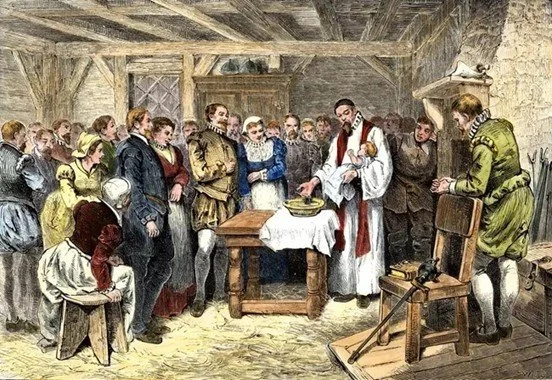
[Photo: The Baptism of Virginia Dare]
White returned to England later that year to obtain additional provisions. His timing couldn’t have been worse. When he arrived home the Spanish Armada was swarming the English Channel. Queen Elizabeth demanded that all ships rally against the Spaniards and White was unable to return to Roanoke Island until 1590. When he arrived, the colony had vanished into thin air. The only clue White found was the word "CROATOAN" carved into a post, as well as the letters "CRO" carved into a tree. He was certain that these inscriptions meant the settlers had relocated to Croatian Island. Before leaving the colony three years earlier, White had left instructions that if the colonists left the settlement, they were to carve the name of their destination, with a Maltese cross if they left due to danger.

[Photo: John White Returns to the Colony]
The fate of those first colonists remains a mystery to this day. Much speculation has been associated with their fate. Interestingly the present-day Hatteras tribe who live on Hatteras Island in the Outer Banks of North Carolina identifies itself as descendants of both the Croatians, the indigenous people who inhabited Roanoke Island, and the Lost Colonists. Without 400 year old bones to confirm this, scientists have been unable to prove that this is the case. I’d like to think that some of the Lost Colony managed to survive.
Estimated to be 400 years old, the Mother Vine, located near the town Manteo on Roanoke Island, is believed to be the oldest grape vine in all of North America. Some say it was planted by the doomed settlers of Lost Colony in 1585. Others that it was planted by the Croatians. This remarkable land was first owned by the Baum Family in the early 1700s. In 1957 the tangled vines of this big mama covered 2 acres of land. Due to neglect, its new owners the Wilsons, had to trim her back to restore her and have lovingly cared for it to this day. This magnificent vine is 120 feet long and 30 feet wide and still producing grapes for wine consumption.
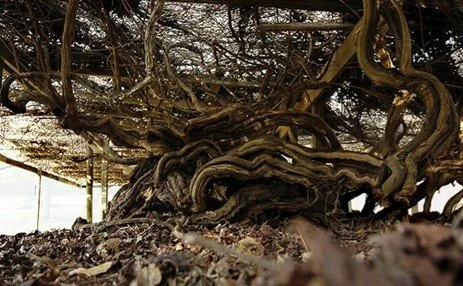
The Ancient Roots of the Mother Vine on Roanoke Island
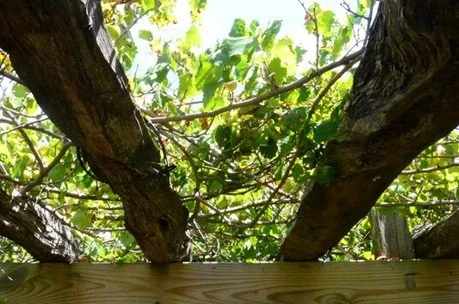
Grapevines on the Ancient Mother Vine
In 1709 London found itself playing host to thousands of Germans who were fleeing famine, war and religious prosecution in their native lands. Many of the first arrivals came from Palatinate region along the Rhine River (the area around Heidelberg). Queen Anne, who reigned Great Britain from 1702 to 1714, at first welcomed the immigrants because she saw it as an opportunity to build colonies in Pennsylvania and the Carolina Islands to produce revenue for the mother country. Initially, she provided subsidies to them to help them make the transatlantic voyage and land grants on their arrival. (This “grant” is less generous then it sounds. It is not a gift; it is the right to purchase a parcel of the land in the New World from the Crown on which annual taxes must be paid. )
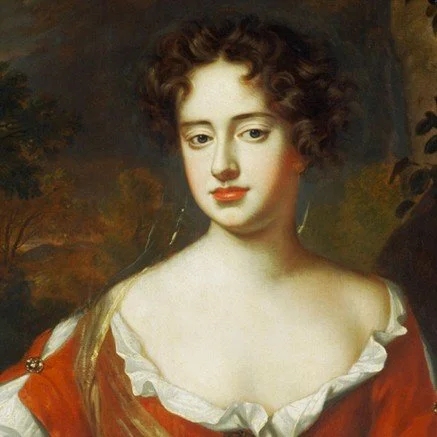
[Photo: The Lovely Queen Anne of Great Britain 1702-1714]
Thirty-four year old Abraham Baum was one of those Palatine immigrants. Abraham is my 7th great grandfather. He arrived at Catherine’s Parish in London on June 11, 1709 with his wife Appolonia and 4 sons and a daughter in tow. On the immigration records Abraham is described as a “husbandman and a vinedresser.” The Baum family were at the beginning of a tidal wave. All told some 13,500 Germans (the so called “1709ers”) flooded into London that year. The refugee overflow was housed in tents and barns in squalid conditions. The Baum family arrived in London relatively early and based on their subsequent success in America, they must have had a degree of wealth. So hopefully they were spared being among the “unwashed masses” that huddled in the refugee camps in London, waiting for a ship.
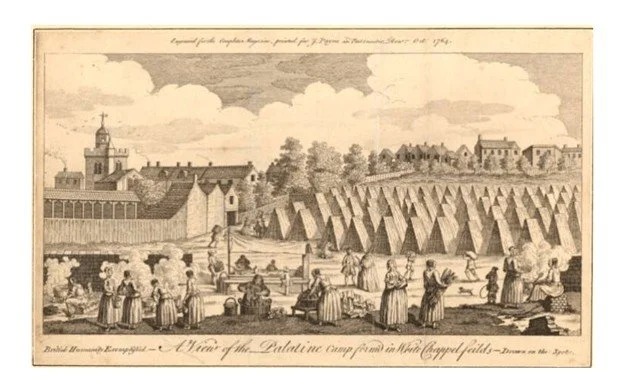
[Photo: Refugee Camp in London 1709]
Londoners grew weary of the onslaught of refugees, many of whom arrived ill and destitute, and the Crown was unable or unwilling to provide support for them let alone fund their passage to settle in America. In November of 1709, a law was passed forbidding the inflow of anymore German immigrants. Queen Anne granted 10,000 acres of land to Christoph Graffenried whose ship carrying 650 Palatine immigrants set sail in 1710 for North Carolina but only half arrived in New Bern. Soon after sadly many of them were killed by the Tuscarora Tribe, the few survivors migrated north. In 1710 a dozen ships left London carrying 3,200 Palatine immigrants to New York; 470 of them did not survive the treacherous voyage. Stories were told of ships unloading passengers who were stripped of their belongings and forced into indentured servitude in America.
It is not known when or where the Baum Family first set foot in America. The first appearance of the Abraham Baum’s name was on the 1715 tax list in Roanoke Island on North Carolina. When he died in 1830 in Currituck County his lands and plantations were divided among his sons Peter, John, Adam and Maurice, my 6th great grandfather. According to the headstone in the family cemetery, Maurice Baum I, the son of Abraham the Elder, was granted 640 acres of land in 1753 and 430 acres of land in 1763 known as the Mother Vine by the Lord Proprietor of the Colonial Province of North Carolina. In 1766 Maurice deeded his daughter Elizabeth Russell 50 acres of land but later in a court record dated 1784 he “excluded and cutoff his daughter Elizabeth Dolbe” (her name from her second marriage) “for diverse causes” and awarded her one shilling. The rest of his estate, which included the Baum Point land and house was left to his two sons Abraham II (1742-1833 – my 5th great grandfather) and Maurice II (1755-1805). The ancient Mother Vine was also part of this parcel of land.
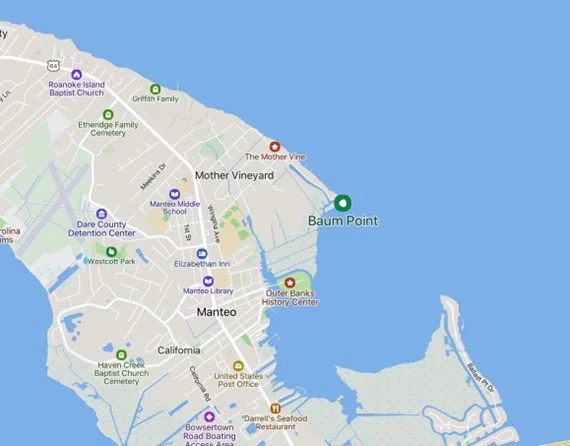
Roanoke Island
8 miles by 2 miles and loaded with Family History
Further north along the coast on the Island (not shown the map) is Fort Raleigh National Historic Site where the Lost Colony settled. settled. According to a newspaper article written in 1932, the Baum family at one time owned the land on which the stump of a live oak had words carved by the Lost Colony. The earliest settlers and the largest farmsteads on the north end of Roanoke Island were the Baums, the Meekins, the Etheridges, and the Midgets.
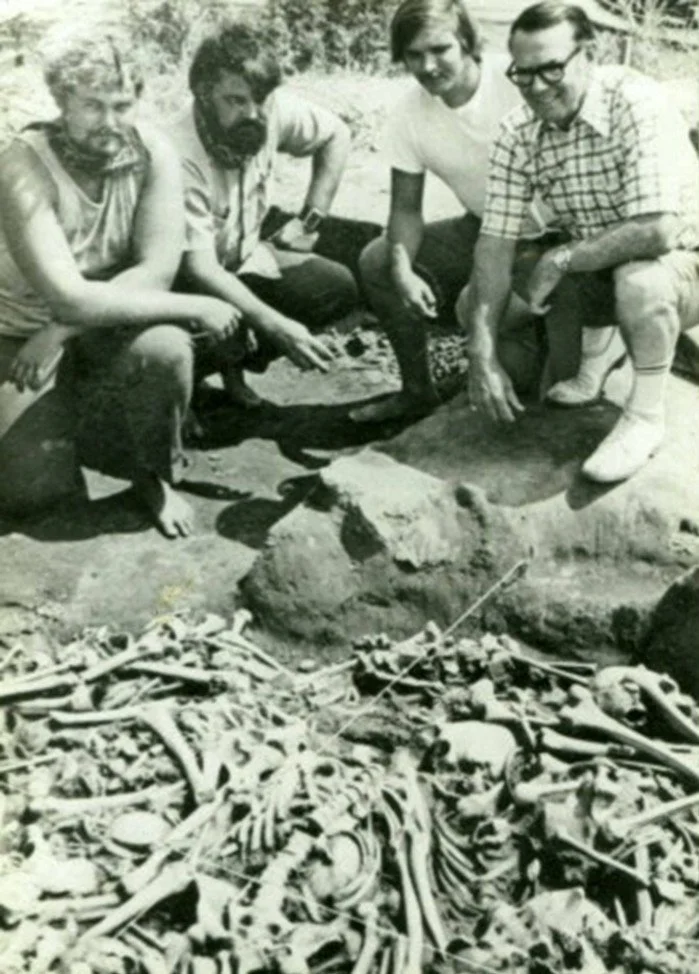
Mass Grave found at the “Baum Site”
The bridge built to connect Roanoke Island to the Outer Banks in 1924 was named for the Baum family. The bridge connecting the Island to the mainland is named Virginia Dare. Also there is an archaeological dig which began in the 1970s called the “Baum Site” in which several mass graves and various artifacts associated with Algonkian Indians were discovered. The findings were dated from the period from the period of early English explorations circa 1586. It was discovered because the owner of the land experienced erosion and was alarmed when human bones started to appear.
Abraham II, the son of Maurice Baum I and grandson of Abraham Baum the Elder, married Susan Mann and they had ten children including Maurice III (born 1772), and Thomas and his twin sister Dorothy “Dolly” (born 1776) and Joseph (born 1780). At the age of fourteen Dolly Baum married Captain Thomas Tillitt. They are my 4th great grandparents on my maternal side. Maurice Baum III married Ann Ashby and they lived in the family ancestral home on Roanoke Island until the property passed by purchase to Isaac Chauncey Meekins who married their daughter Mahala. The house became known as the Baum-Meekins House.
All of Abraham II’s children, including Dolly Baum, would have grown up in this house as children. I found a picture of this house taken in 1930 and although the house had fallen into disrepair what is extraordinary about the photo is the presence of the famous grapevine which is clearly evident next to the house. The house has since burnt down but the Mother Vine is still alive and well.
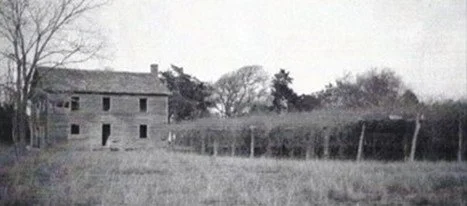
[Photo: Baum Meekins Home Circa 1930. Note the Mother Vine to the right of the house.]
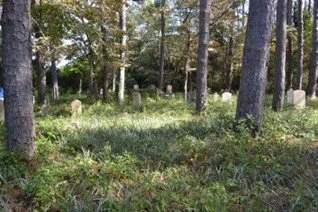
[Photo: Baum-Meekins Cemetery in 2019]
Many members of the Baum family found their final resting place in the Meekins Baum cemetery on the property.
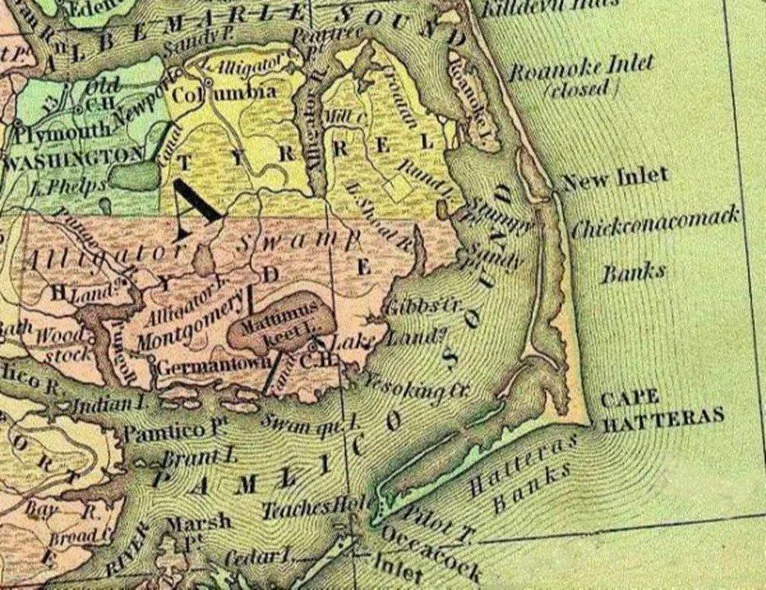
[Photo: Map of Hyde County in 1834]
After a career as a sea captain, Dolly’s 39 year old twin brother, Thomas Baum, bought 475 acres on the north side of Lake Mattamuskeet in Hyde County across the Pamlico Sound including 275 acres known as Sicamoreland and the adjoining 200 acres from their father.
It is amusing to note that Lake Mattamuskeet on this map is surrounded by the “Alligator Swamp.” Thomas married Mahala Swindell, and they had five children: Abraham, Samuel Lindsay, Edward Stanley, Sarah Mann, and Josiah Blackwell. Thomas built houses for four of his children creating a family compound. His circa 1816 house has been beautifully renovated and is currently occupied and nicely maintained by his descendants. I am guessing the alligators are long gone. Today Thomas Baum’s descendants regularly hold reunions on this property.
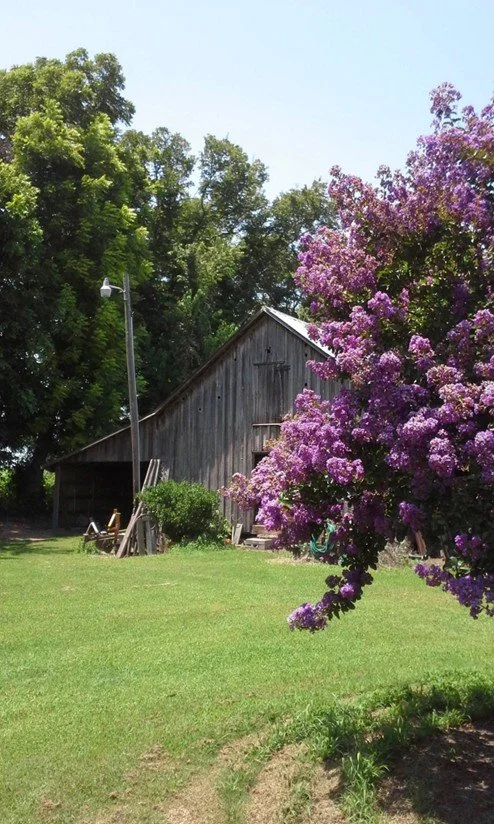
[Photo: Thomas Baum’s Barn circa 1816]
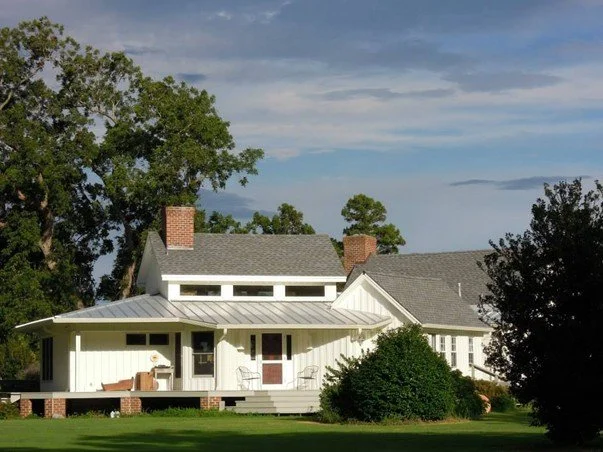
[Photo: Thomas Baum’s home (renovated) as of 2015]
A picture of Thomas Baum and those of his two sons, Stanley Lindsay Baum and Josiah Blackwell Baum follow. Unfortunately, I was not able to find any pictures of his twin sister, Dolly, or any of his other siblings or children.
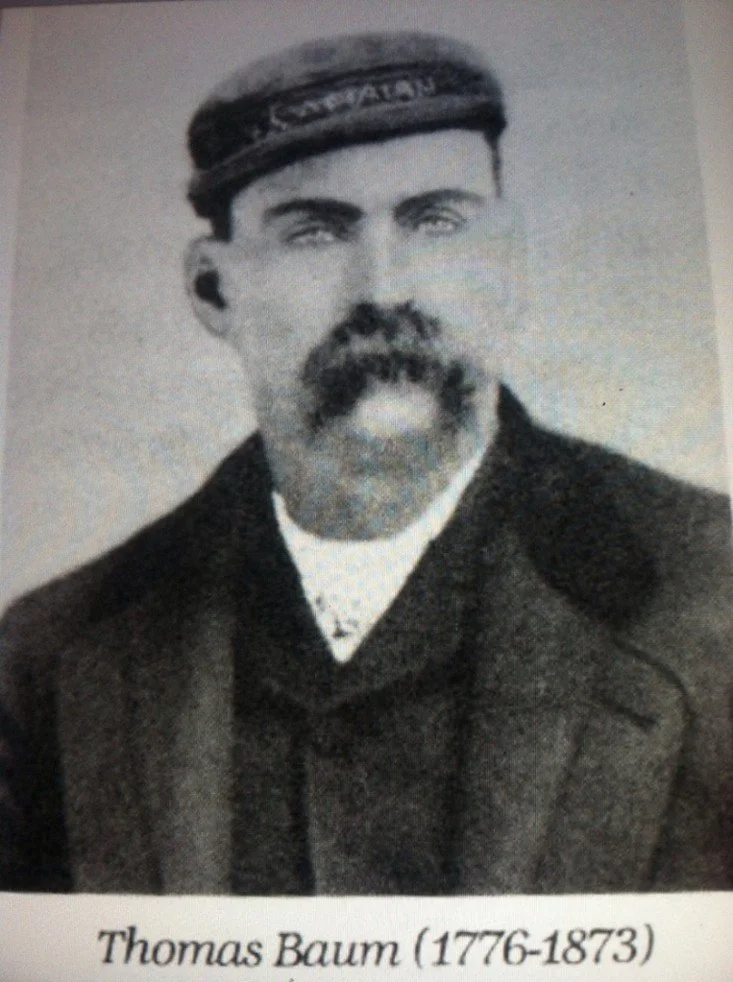
[Photo: Thomas Baum (1776-1873), Sea Captain. My 4th great grandmother Dolly Baum’s twin brother.]
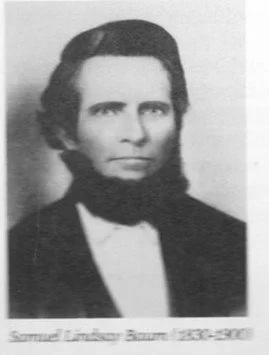
[Photo Samuel Lindsay Baum (1830-1900), son of Thomas. Farmer, married twice and had at least eleven children.]
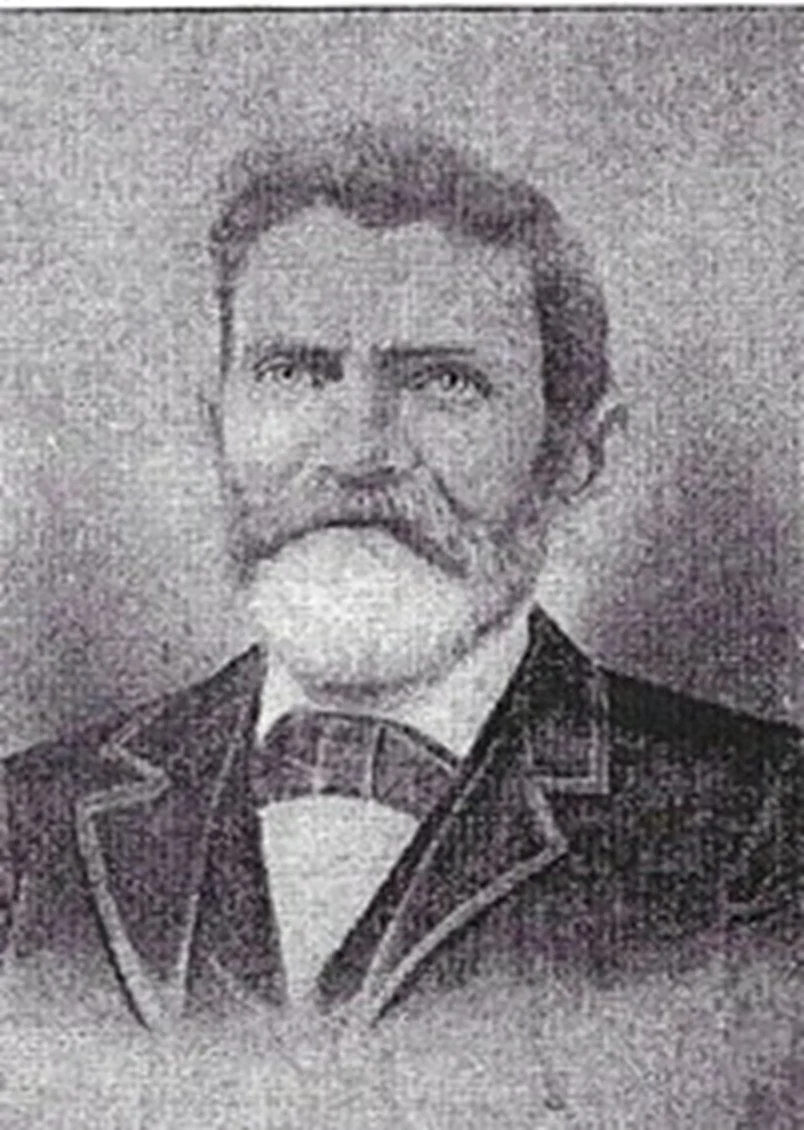
[Photo: Josiah Blackwell Baum (1842-1907), son of Thomas Baum. Hyde Ranger during Civil War, the Rangers operated in Union-controlled territory to disrupt enemy lines and secure provisions for the Confederate Army.]
Thomas’ son, Edward Stanley, was captured for violating the Hatteras blockade and was imprisoned as a POW. This occurred in 1861 when the Union forces captured two Confederate forts guarding the Hatteras Inlet in an effort to blockade runners from entering the Carolina Sounds. The Union occupation of the Island created one of the first “contraband camps,” called Hotel d’Afrique, which became a haven for formerly enslaved people seeking freedom.
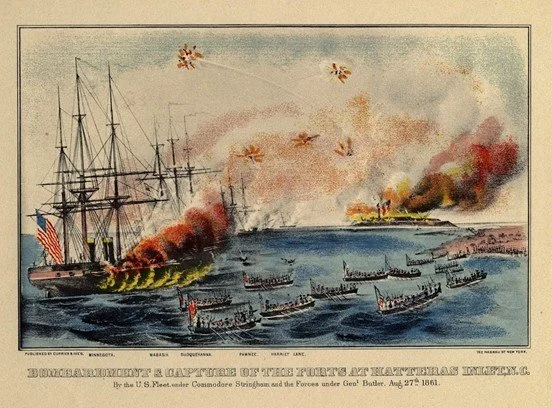
[Photo: The Battle of Hatteras]
Thomas’ son Adam went blind later in life.
Thomas’ only daughter, Sarah Mann, was named after her grandmother, the wife of Abraham Baum II. She married a tailor, Robert Dillon.
I couldn’t find much information about Thomas and Dolly Baum’s brother, Joseph Baum (1780-1854). In the 1850 census he was 70 years and listed his occupation as “none”. He was living with his wife Elizabeth (Mercer), who was 20 years younger than him, and five children between the ages of 15 and 26. I kept digging and finally hit pay dirt. Joseph and Elizabeth had a daughter Chloe. She married Jasper Beauregard White, and they had a son named Leonidas Robert White.
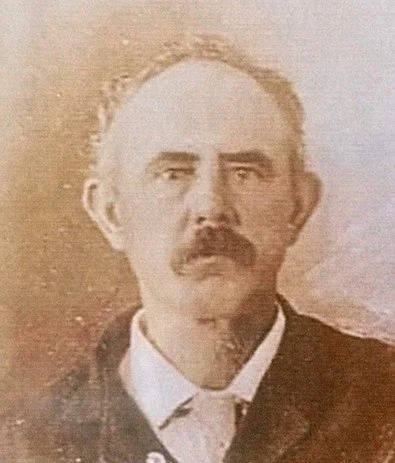
[Photo: Leonidus Robert White, Murder Victim]
I found the following juicy newspaper article about Leonidus from the Raleigh News and Observer in 1913.
On September 6, 1913, Leonidus Robert “Leon” White, well-to-do owner and proprietor of Currituck Inlet Club on the northern Outer Banks, succumbed to a gunshot wound to the head sustained days earlier. He was found unconscious in this condition, presumably shot by his wife Maggie over a property dispute. Maggie was initially held by the Sheriff on suspicion of murder, since Currituck County jail could not hold women. However, the murder weapon could not be found, and the prevailing sentiment in the county was that all evidence was circumstantial. After all, Maggie was the mother of 13 children, some still young and in the home. Leon never regained consciousness and was unable to give testimony as to what had happened. His now-widowed wife Maggie plead innocence to the charge of murder, and claimed it was a suicide. Her story tended to change from time to time, having initially said a stranger must have shot her husband in passing. That was a more plausible explanation than suicide, since there was no weapon found near her unconscious husband.
In the end, Maggie was cleared of all charges. She may have been a sweet, dear mother of 13, but even her children knew she was not a woman to be trifled with. "Our own Lizzie Borden," quips descendant and northern Outer Banks historian Barbara Haverty Pardue. The murder weapon was not found until years after Mrs. White's passing. She had buried it in the rose garden.
Mahala Baum (Dolly Baum and twin brother Thomas Baum’s niece) and Issac Chauncy Meekins who lived in the family ancestral home “Baum-Meekins House” on Roanoke Island had four children. It is interesting that one of them, Edward Newton Meekins (1862-1917), filed a petition in 1903 to have his last name formally changed to Macon. I was not able to find the reason he felt it was necessary. Edward fought as a Captain in World War I and is buried in Arlington Cemetery.
Mahala Baum had a brother named Benjamin who only lived to the age of 34. His daughter Frances Baum (1826-1894) had a family whose lives capture the colorful history of life on the Outer Banks during their time. Frances married Adam Dough Etheridge IV. (Her children are the grandnephews and grandnieces of my 4th great grandmother Dolly Baum).
Frances and Adam’s son Patrick Henry Etheridge, known as “Captain Jack”, worked in a lifesaving station near Cape Hatteras for the US Coast Guard. In the late1800s the ocean waters off of Hatteras Island were among the most traveled, and the most dangerous for coastal mariners, due to the infamous Diamond Shoals. The US government was forced to step in after dozens if not hundreds of shipwrecks were recorded in the region. Hatteras Island and the Outer Banks soon became home to a handful of US Lifesaving Stations, which were manned by some of the most decorated Lifesaving Service crew members of all time. Captain Jack was among them. One stormy night he and his crew were preparing for a lifesaving mission. One concerned bystander shouted: “Jack, if you go out with on those winds you’ll never make it back!” He famously replied, “The blue book says we’ve got to go out, but it doesn’t say a damn thing about having to come back.” The saying has become the Coast Guard’s unofficial motto.
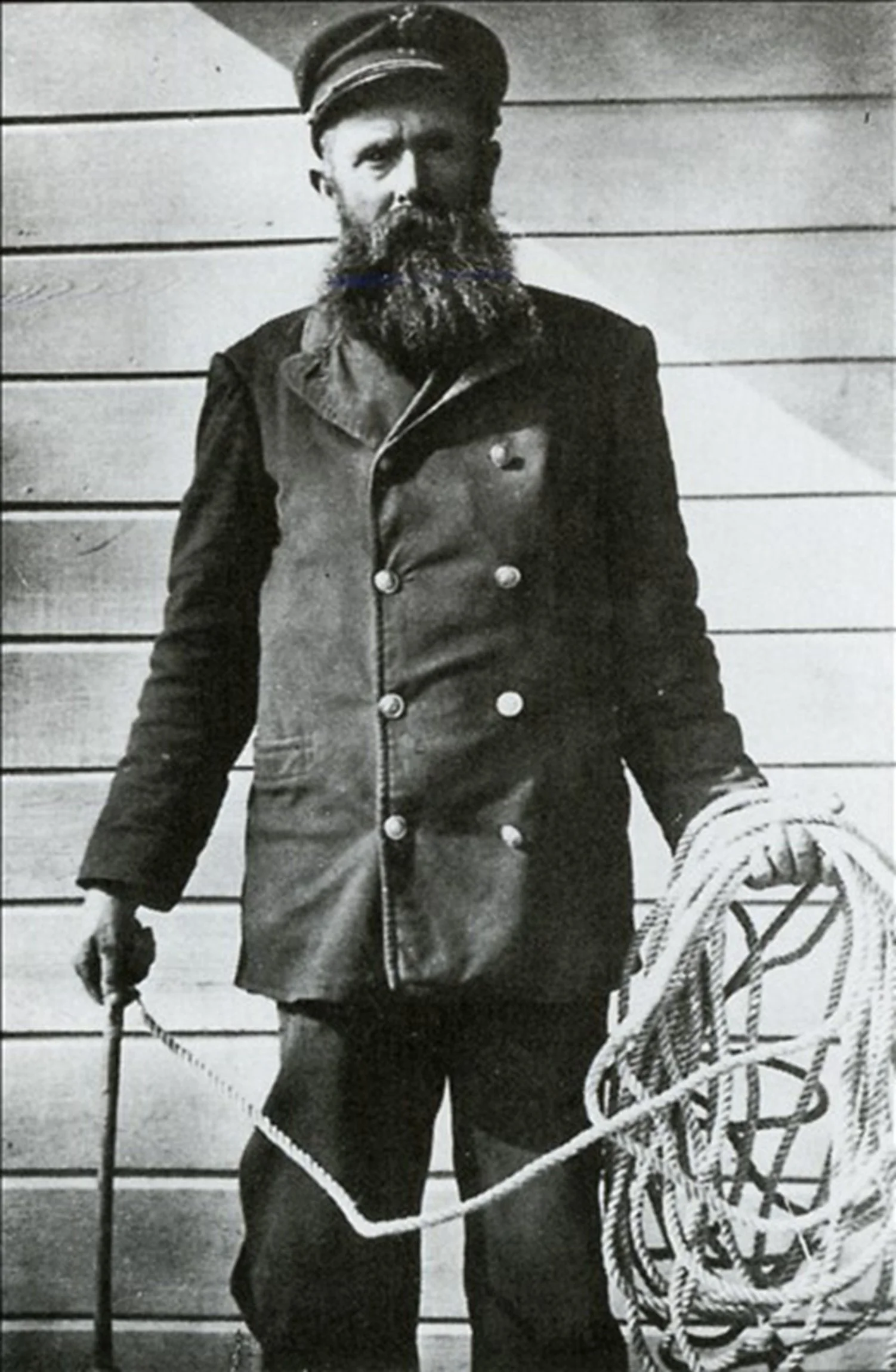
[Photo: Local Legend Captain Jack Etheridge]
“The blue book says we’ve got to go out, but it doesn’t say a damn thing about having to come back.”
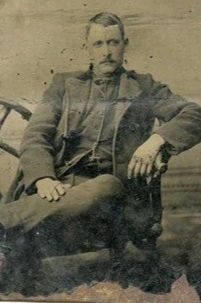
[Photo: Adam Dough Etheridge, V, Fisherman and Boat Pilot]
Frances Baum and Adam Dough Etheridge’s IV’s son, Adam Dough Etheridge V, was a fisherman and boat pilot. Their son Jesse Benjamin, worked for the Bodie Island lighthouse and US Coast Guard life station and was the superintendent of the Pea Island Game Reserve. Their daughter Josephine was a well-loved Sunday school teacher whose twelve sons all worked for the Coast Guard or other maritime professions. Their youngest son, Augusta Holly “Gus” Baum, wasn’t sure who he wanted to be, and so he tried all of the family professions and then some. When his father died at the Old Home Place, the seven year old heartbroken boy, devoid of the usual fear of death and the dead, begged to be permitted to sleep the last night beside the body of his beloved father. People in town were shocked, but his mother allowed Gus to do it.
Gus tried his hand at cattle ranching in Texas, but after a year he decided it wasn’t cut out for it. He returned to Dare County, North Carolina took up fishing, married Miss Roxie Etheridge who lived at a neighboring farm, and entered the coast guard service where he spent the next 15 years.
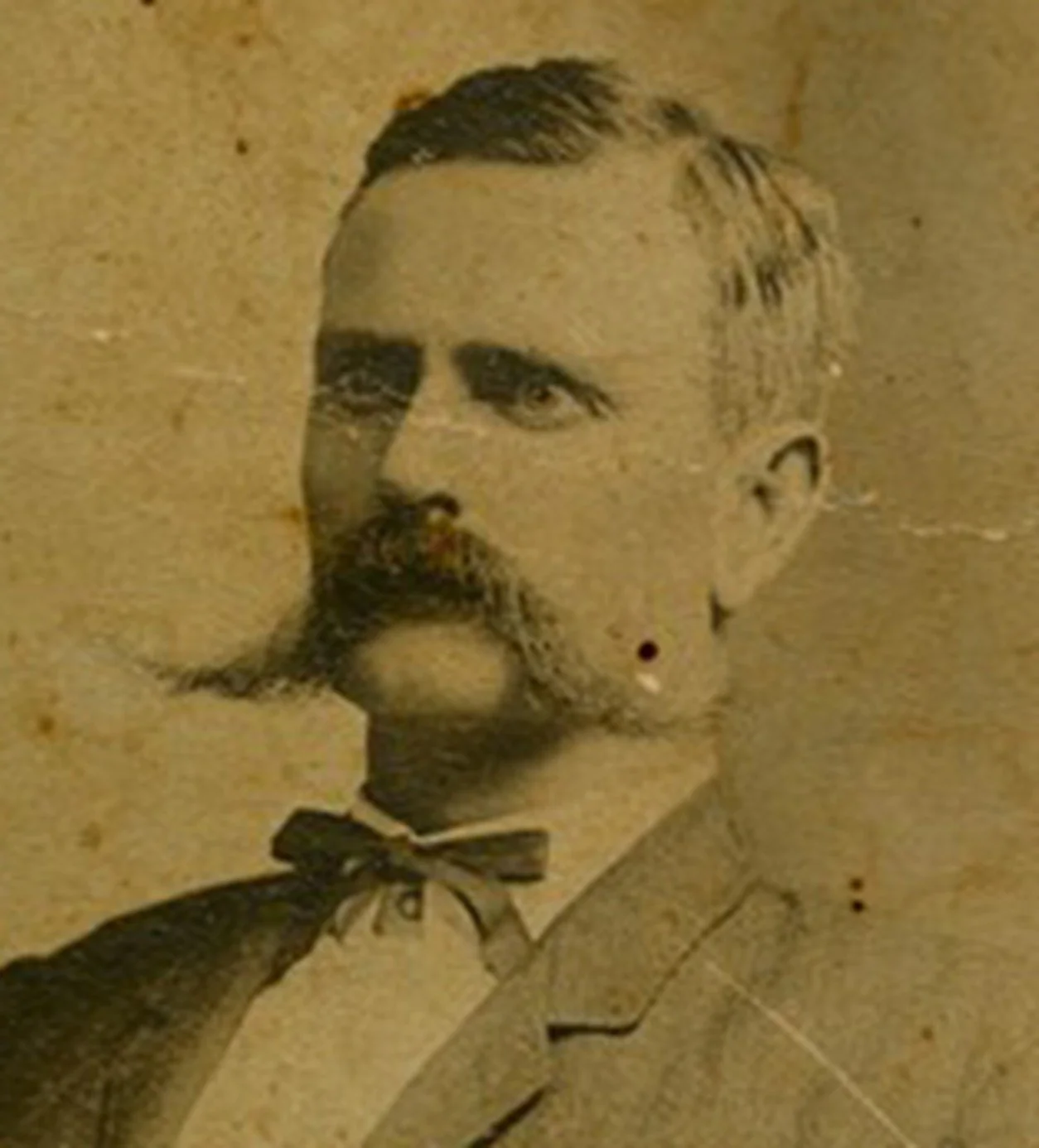
[Photo: Augustus Holly “Gus” Etheridge 1860-1941, Cattle Rancher, Coast Guard Service, Hotel Manager, Sheriff, Legislator, Head of Detective Agency, Lighthouse Keeper, and BEST mustache!]
Gus and Roxie had three children, Amanda, Thomas Dixon and Fannie. He served as sheriff and temporarily moved to Norfolk where he ran a hotel during the 300th celebration of the founding of Jamestown in 1907 and then returned to serve another 2 year term as sheriff. In 1920 the Elizabeth City Independent newspaper reported that a mysterious grave was found in the woods near Gus’s farm. Some people in town were convinced it was someone murdered one of the “revenue men” who had recently visited Roanoke Island. Others thought it was a “negro offspring” that had been secretly buried. Flowers on the grave confirmed this theory. Ultimately, it was discovered that it was one of his brother Adam’s hogs that had died and was buried with much ceremony as a joke.
Gus served two terms as a state representative and later became the head of a detective agency. The last 11 years of his working life were spent in the family tradition as a lighthouse keeper. He died in his sleep at the ripe old age of 80 in 1941. After his death his widow, Roxie was offered $50,000 for their home. The rich buyer was mostly interested in cutting down the majestic old elm trees and red cedar trees that lined their driveway. Roxie turned him down, saying she would rather cut off her hands than part with the trees that her husband had so lovingly planted and cared for. Roxie, who had been active in church and community affairs, passed away two years after her husband and the “floral offering was one of the largest ever seem on Roanoke Island, bearing witness to the esteem in which she and her family were held.”
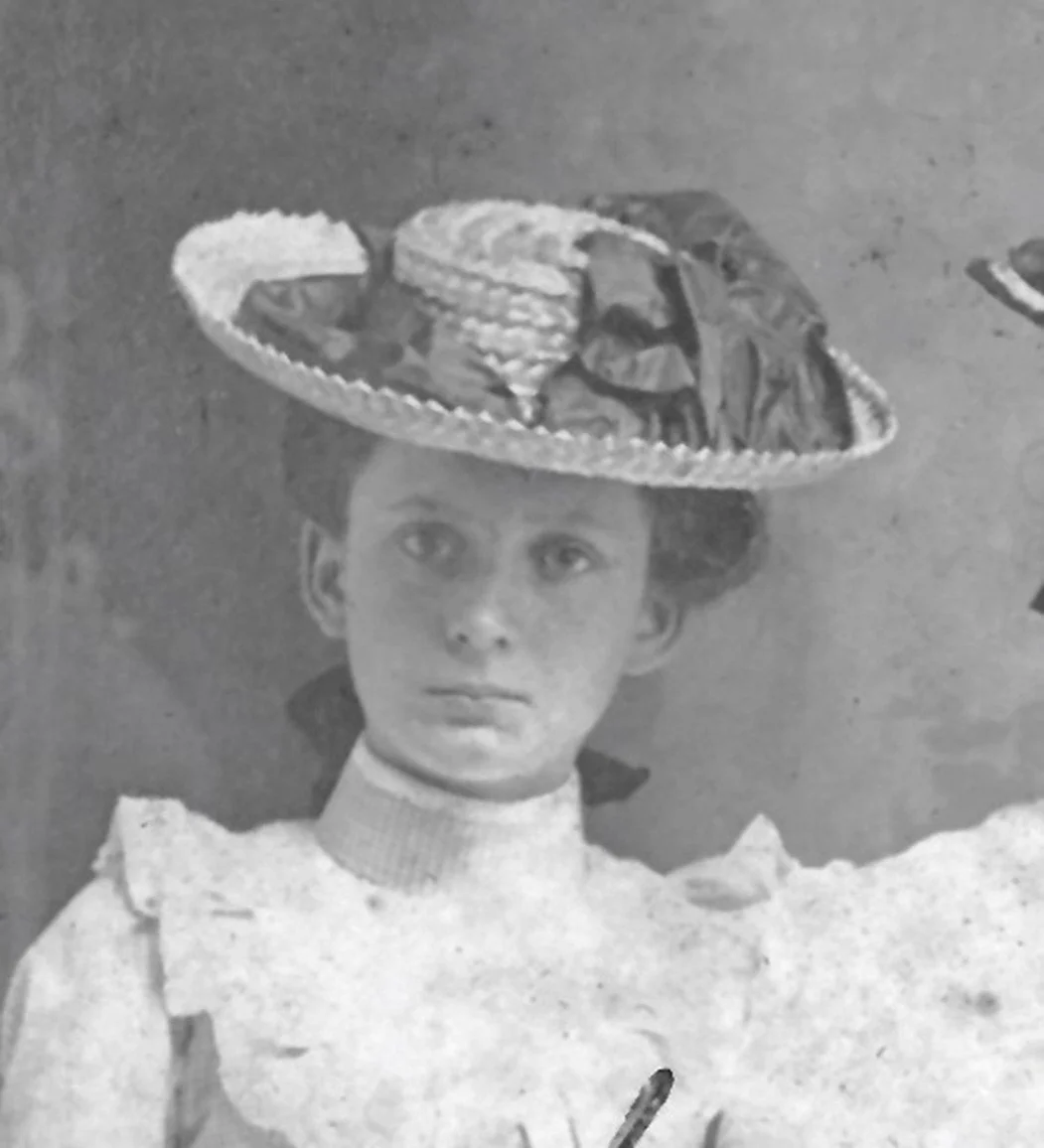
[Photo: Amanda Etheridge (1888-1945), Daughter of Gus and Roxie Etheridge]
Ten years after Gus’s father died, his mother remarried Captain Thomas Allen Dough Jr, a farmer and fisherman who worked for the Nags Head Coast Guard.
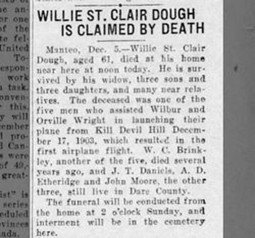
Captain Thomas Allen Dough’s nephew, Willie Dough, also worked for the US Coast Guard and had the honor of assisting Wilbur and Orville Wright in launching the first flight from Kill Devil Hills on December 17, 1903. Also present on the miraculous day to assist in the launch was Frances Baum Etheridge Dough’s grandson, Adam Dough Etheridge VI, who also worked for the Coast Guard. The flight lasted 12 seconds and went 120 feet at an altitude of 10 feet. They made three more flights that day the longest being 59 seconds covering 859 feet. It was a miraculous achievement that would change the world. As Neil Armstrong said 66 years later on the moon, “one small step for man, one giant leap for mankind.”

[Photo: The First Flight, December 17, 1903]
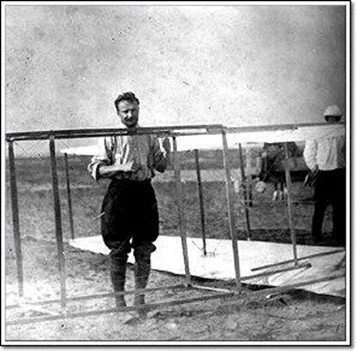
[Photo: Willie St Clair Dough (1870-1931]
When Willie Dough died in 1931 his obituary was nearly all devoted to that proud day when he assisted the Wright brothers in the first flight.
[Photo: Willie Dough Obit.]
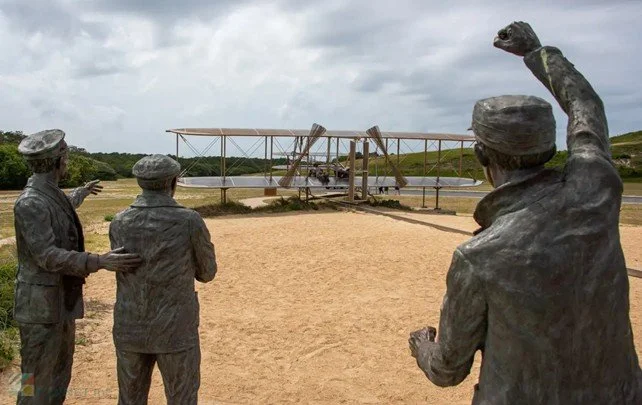
[Photo: Wright Brothers National Memorial Statute in Kill Devil Hills. On the far left is Adam Dough Etheridge VI wearing his life saving station hat.]
I was delighted to find this picture of Amelia Earhart, the first female pilot to fly solo non-stop across the Atlantic Ocean, celebrating the first flight with our ancestor Adam at the Wright Memorial Ceremony in 1928.
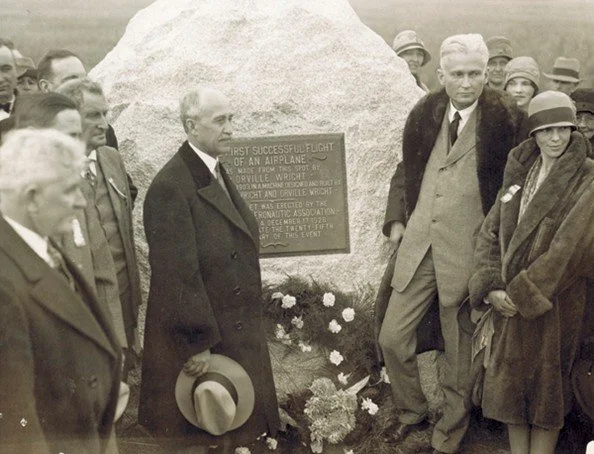
[Photo: From Left to Right: John Daniels, Unknown (perhaps Willie Dough?), Adam D Etheridge VI, Orville Wright, Senator Bingham, and Amelia Earhart in 1928.]
Sadly, nine years after this photo was taken. Amelia disappeared over the Pacific Ocean while attempting to be the first female pilot to circumnavigate the world. But oh what a legacy she left behind. As a child Ameila spent hours playing with her sister Pidge, climbing trees, hunting rats with a rifle, sledding downhill and collecting all manner of small creatures: worms, moths, katydids and tree toads. A year after Wright’s first flight with the help of her uncle, Amelia Earhart constructed a home-made ramp that was fashioned after a roller coaster she had seen on a trip to St. Louis, Missouri, secured it to the roof of the family tool shed and attempted to fly. Following Amelia's first flight, she emerged from the broken wooden box that had served as a sled with a bruised lip, a torn dress and a "sensation of exhilaration", saying: "Oh, Pidge, it's just like flying!"
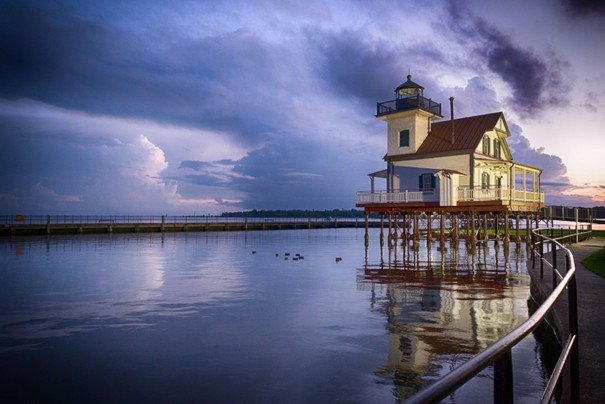
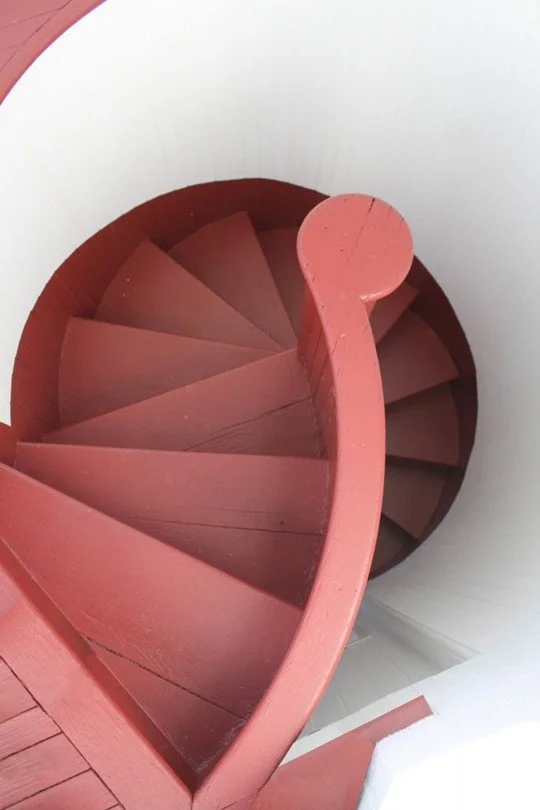
The pictures that follow are of the restored Roanoke River Lighthouse which was originally built in 1886. They capture the quiet majesty of the lighthouses of that long ago era and are a reminder of the selfless heroism of the lighthouse keepers and coast guard station crews.