John Edward Cobb, Sr. (1885-1940)
My Paternal Grandfather, married Francis L Ricks

John Edward Cobb, Sr (“Ed’), the son of William Edward Cobb and Celia Martha Spivey, was born on September 3, 1885 in Bertie County, North Carolina. His father died when Ed and his brother Tom were just toddlers. Ed’s father had been a successful merchant and journalist before his untimely death at age 45. When the young boys lost their father, their 28 year old mother could not support them, so she and the boys moved into their Uncle John Grant and Aunt Mary Spivey Grant’s household in Windsor, North Carolina. Their mother never remarried and died eleven years later in 1899. Ed and Tom were barely teenagers. They helped their Uncle John by working as laborers on the family farm.
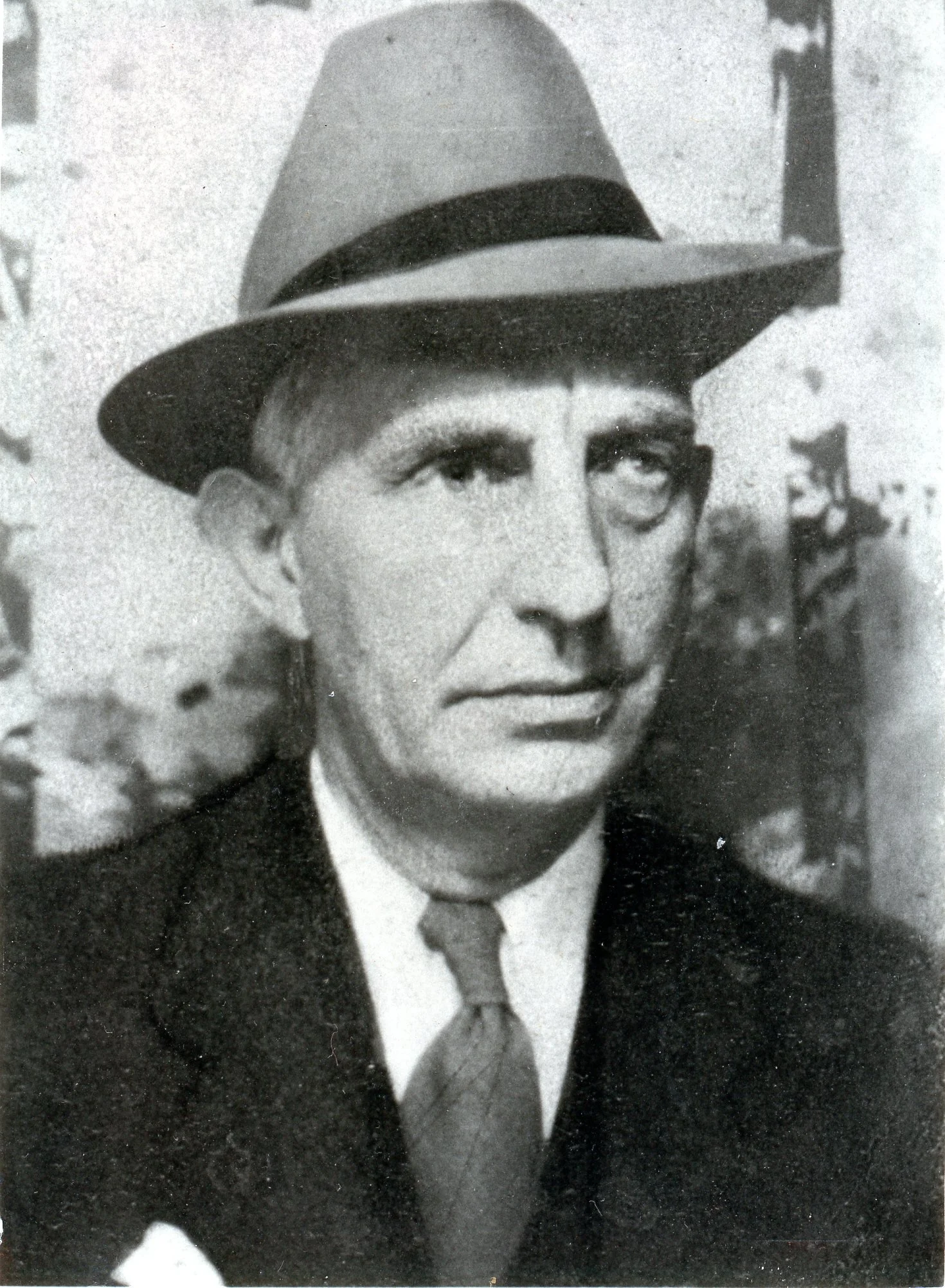
When Ed turned 21 in 1906 he was eligible to receive the inheritance money his mother had left him. He received $700 (the equivalent in today’s dollars of about $19,500.) Ed used the money to travel to Europe. The more practical Tom used his to start a retail business. Ed was a shy man who hated having his picture taken. The picture of him at right is one of only a handful of him that exist.
[Photo: John Edward Cobb, Sr. 1885]
In the 1910 census Ed was single, 24 years old, living in a boarding house in Woodville, North Carolina and working as a salesman in a general store. His brother Tom was unemployed and living on a farm with another of their uncles, James W. Spivey Sr. James had been in business with their father, William, the year William unexpectedly died of pneumonia.
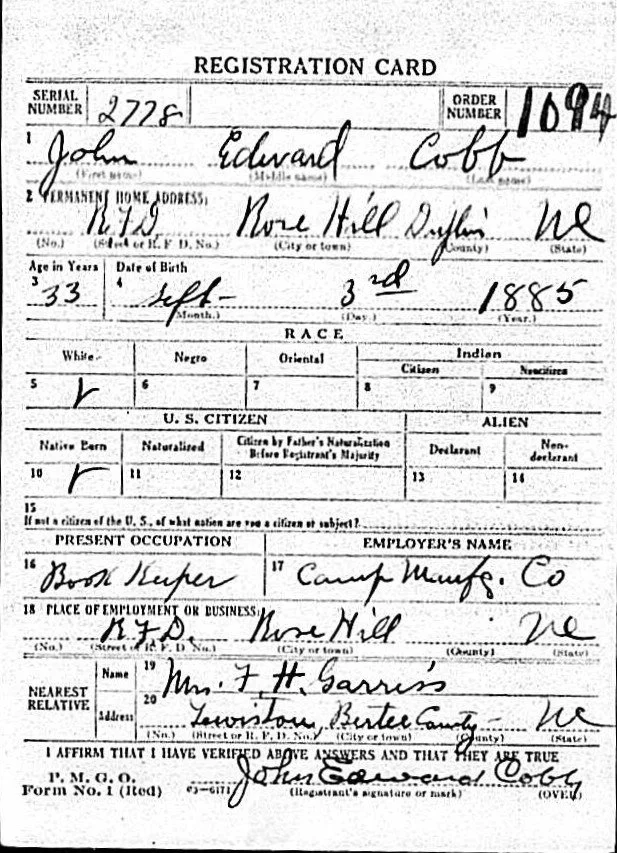
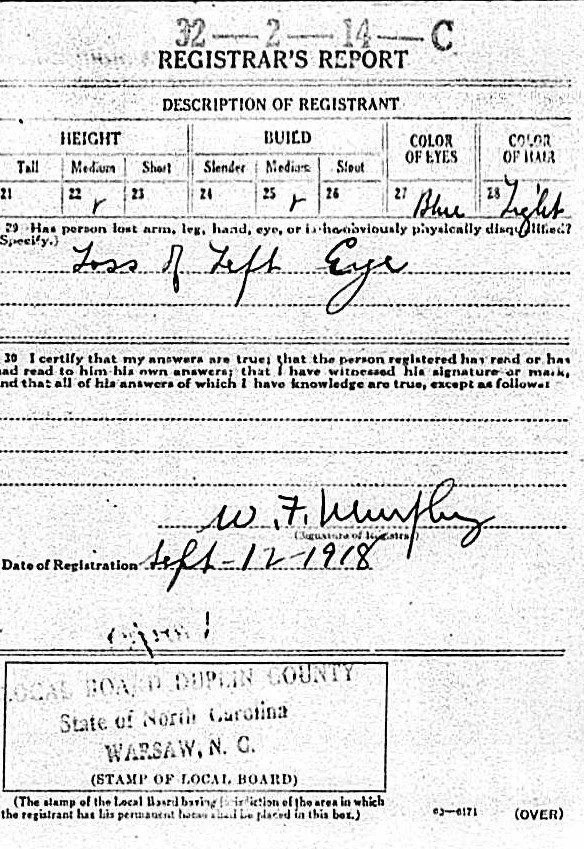
In September of 1918 Ed registered for the World War I draft. He was never called up to duty most likely because his draft card said: “loss of left eye.” He listed his closest relative as Mrs. F. H. Garris (the married name for Florence Spivey, his mother’s sister).
[Photo: Ed Cobb’s 1918 Draft Card World War I]
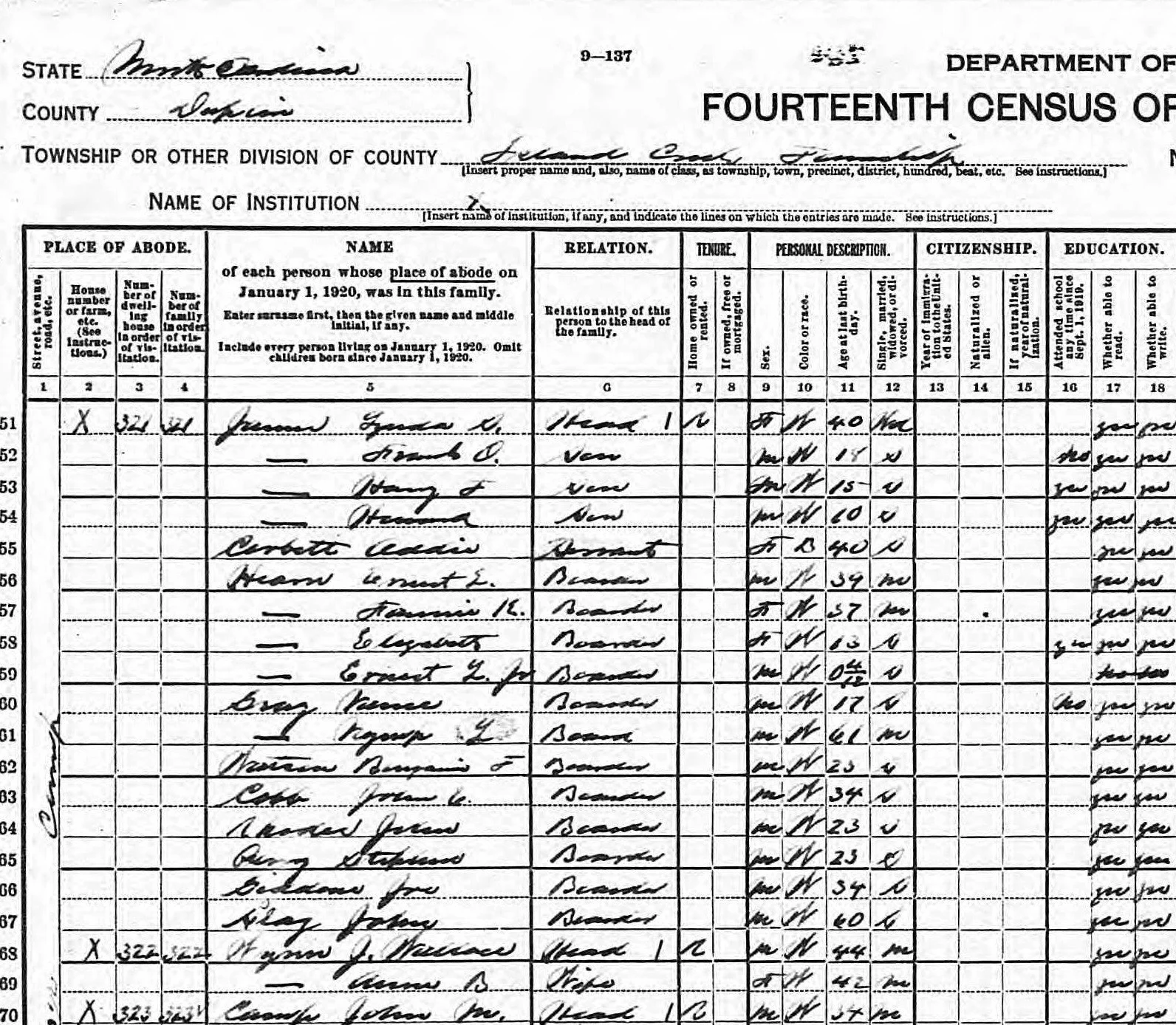
In the 1920 census Ed was single, 34 years old, and living in a boarding house in Island Creek in Duplin County, North Carolina, working as a clerk for Camp Manufacturing Company, a multi-state lumber enterprise. That year his brother Tom had moved in with his cousin Florence and her husband, Frank Garris. Tom was single, 31 years old and in the general merchandise business.
Interestingly in the 1920 census, there was a man named Thomas Blount Ricks, Sr who was also living in Island Creek and working at the Camp Company sawmill. Thomas had a 16 year old daughter named Francis “Fannie” Ricks. Fannie was to become his future wife.
[Photo: 1920 Census in Island Creek, South Carolina. Ed is on line 63]
In August of 1922 Ed put an end to his boarding house life and married Fannie Ricks, who at eighteen years old, was half his age. The couple moved to Wallace, North Carolina where Ed managed one of the Camp Family company stores. There Fannie gave birth to their three children John Edward Cobb Jr (“Jack”) in 1924, Martha Langley in 1926 and Mary Ann in 1928. Jack was my father.
The stock market crashed in 1929. It was the beginning of the Great Depression which brought nearly a decade of economic suffering and despair for many families. Although the logging industry was one of the industries that suffered the most during the depression, fortunately, Ed was able to maintain his employment.
When the store in Wallace was closed Ed was transferred to Franklin, in Isle of Wight County, Virginia to manage the company store there. In the 1930 census Ed found himself once again living in a boarding house. He lived in Franklin, but his wife and children were not living with him. A year later he was transferred to Russellville, South Carolina to manage the mill store there and the family was reunited. His employer provided them with a modest company owned house to live in.
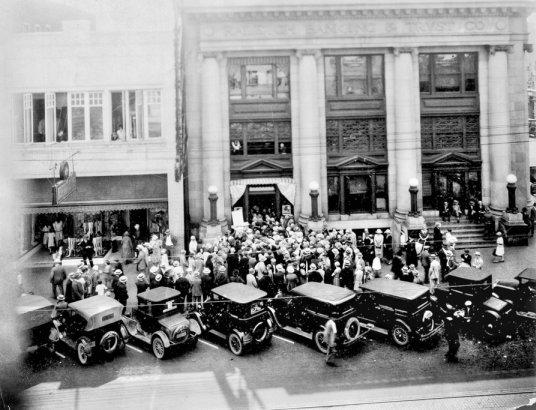
[Photo: Bank run during the Great Depression in 1933 at the Raleigh Bank &Trust. Between 1929 and 1933 215 banks in North Carolina failed.]
In 1937 Ed’s health began to fail. In the April 1940 census, the family was living together in a rented home in St. Stephens, four miles from Russellville. Ed had retired from the Camp Company and was employed as the local postmaster working 40 hours a week for $2,940 per year (the equivalent of $54,400 today) and while his industrious young wife Fannie worked 60 hours a week as a clerk in a retail grocery for $840 per year (worth $15,418 today). Jack was 16 and in his senior year of high school, his two sisters were 14 and 12, respectively.
{Photo: Ed Cobb, date unknown]
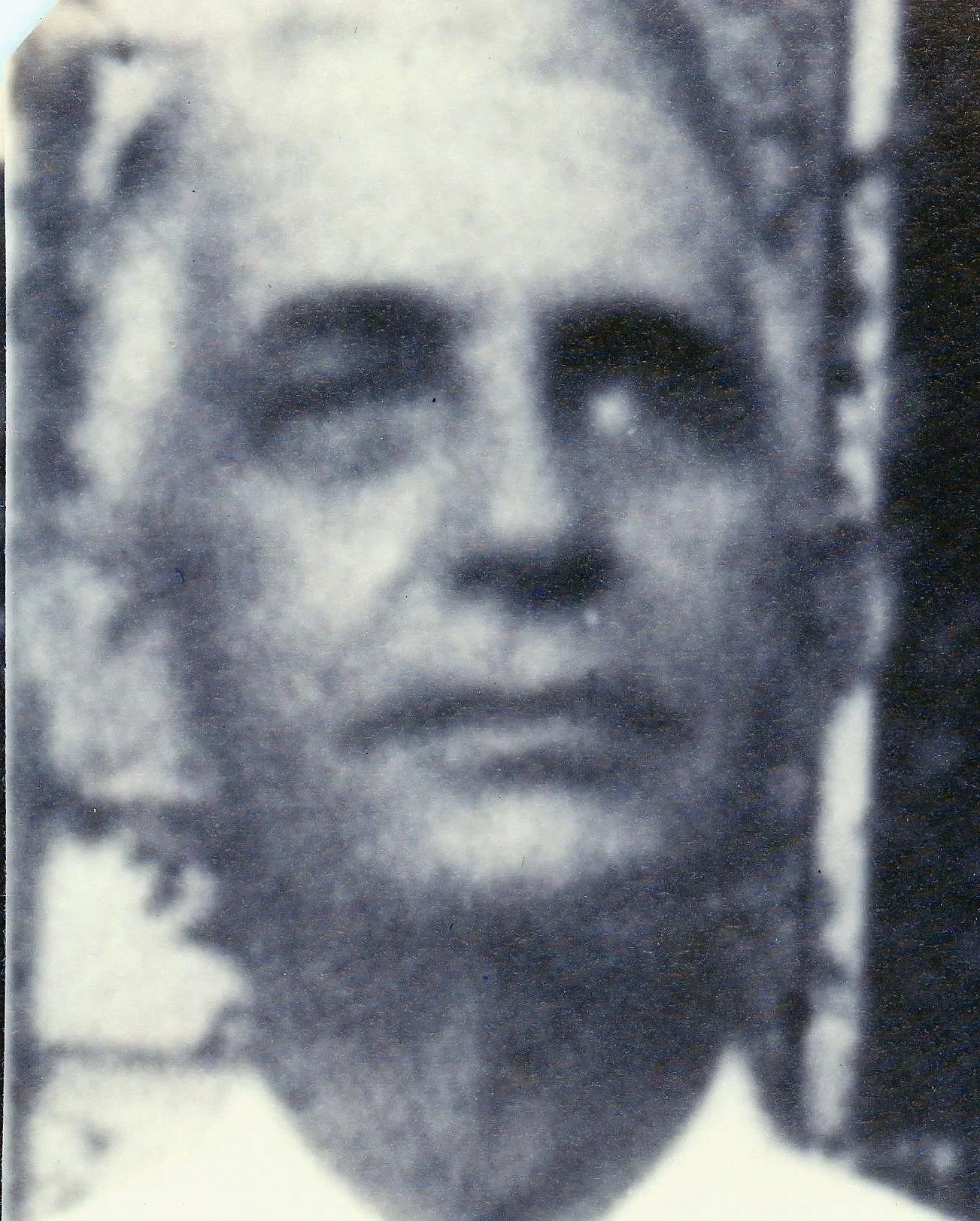
In May of 1940 Ed was diagnosed with terminal colon cancer and four months later, just as his son Jack was about to attend The Citadel Military College, he was gone. In gratitude for his years of service to them, the Camp Brothers generously stepped in to help Ed’s 33 year old widow, Fannie, get set up in her own grocery business so she would be better able to support herself and her children.
The Camp Family could afford to be generous. Camp Manufacturing Company was founded in 1887 by three Camp brothers who started their operations with the purchase of a small sawmill on the outskirts of Franklin, Virginia. The onset of World War I greatly increased demand for lumber and by 1918 “...tiny Franklin was a booming war time village.” Despite the depression, toward the end of the 1930s, the Company had been able to expand their operations into multiple states and added paper and pulp products to their portfolio.
Had Ed been able to survive his illness he might have been able to achieve some financial security for his family. (By 1955 Camp Company annual sales reached $28 million. It eventually merged with another “timber tycoon” and in the 1990’s was eventually acquired by International Paper.) However, despite the help the Camp brothers provided in 1940, Fannie had to struggle to make ends meet.
[Photo: The last known photo of Ed]
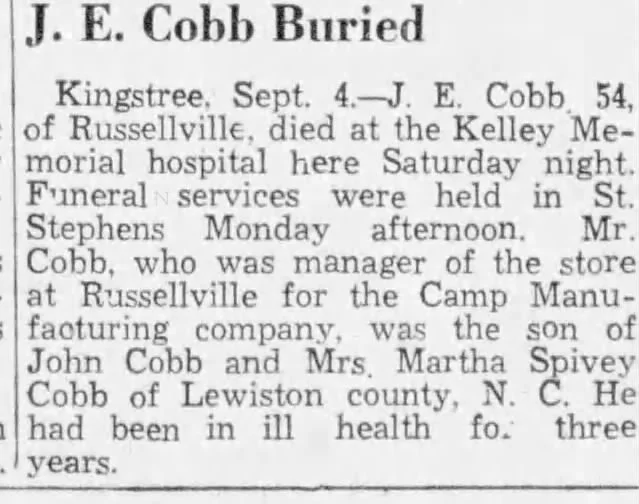
Ed’s obituary was very brief. Not too surprising, given that his early death must have created a great deal of uncertainty and angst for the family. However, I do find it odd that his wife and children were not mentioned. His life remains remains largely a mystery to me.
After my father and mother were married in 1949 they went to visit the Camp family. Dad wanted to thank them for what they had done to help his mother in her time of need. My mother recalls being awe-struck by the Camp family’s grand home. It was the first time she had ever seen a private residence with an elevator and the house was filled with artifacts from their travels to Africa and other places around the world.
[Photo: Ed Cobb’s Obituary 1940]
