The Latham Family
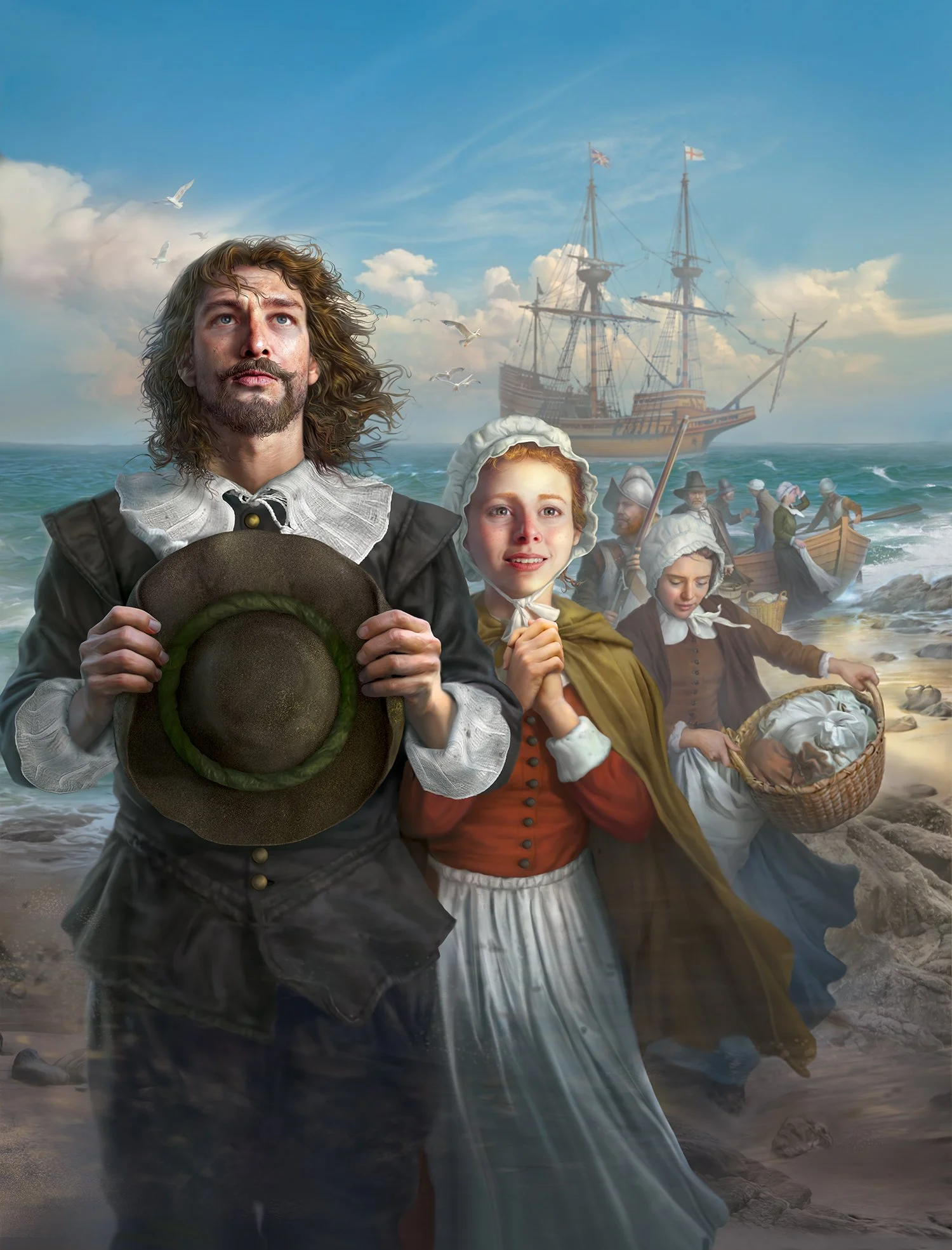
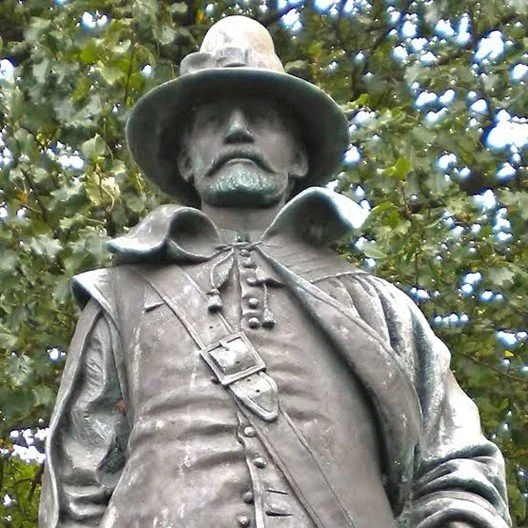
Being able to trace your ancestry back to the Mayflower is seen as a mark of prestige and historical significance. The voyage was a crucial moment in American history. We admire the Pilgrims for their courage, resilience, & unrelenting determination. Their DNA courses through the veins of at least nine US Presidents. William Bradford at the age of thirty was elected a leader of the Colony and then re-elected 31 times before his death. His statue is the quintessential face of the Pilgrim Colony. Clint Eastwood can trace his lineage to this man. An indentured servant named John Howland was swept overboard in a storm on the Mayflower but miraculously grabbed a rope and hoisted himself back onto the ship. His lineage is connected to Ralph Waldo Emerson. Ernest Hemingway and Amelia Earhart can trace their lineage to Mayflower passenger, Richard Warren. John Alden’s DNA resides in the largest number Mayflower descendants, including Marilyn Monroe, Raquel Welch and Emily Post. In short, if you can trace yourself to this mighty ship you are in good company.
[Image: Statue of William Bradford, Leader of the Plymouth Colony]
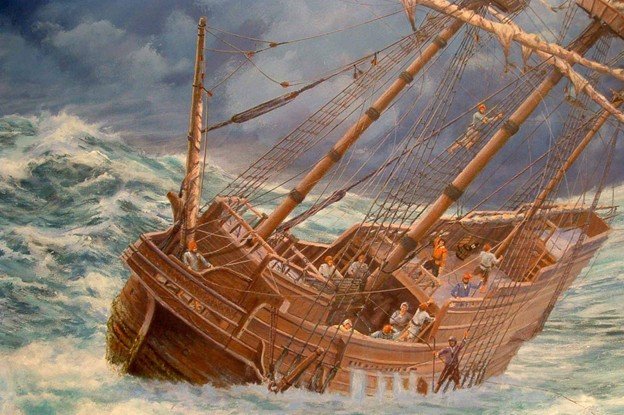
The Mayflower was about 100 feet long from stem to stern and a mere 24 feet wide. Its living space was a tiny 58 feet by 24 feet. It was designed to haul lumber, fish and casks of French wine—not passengers. Its rigging and high ceiling compartments were suited for short journeys along the European coastline, not for sailing against the fierce Westerly winds of the North Atlantic. Remarkably it managed to make its way to the New World but missed its intended target, the settlement of Jamestown in Virginia, by a surprisingly large margin.
[Image: The Mayflower Voyage]
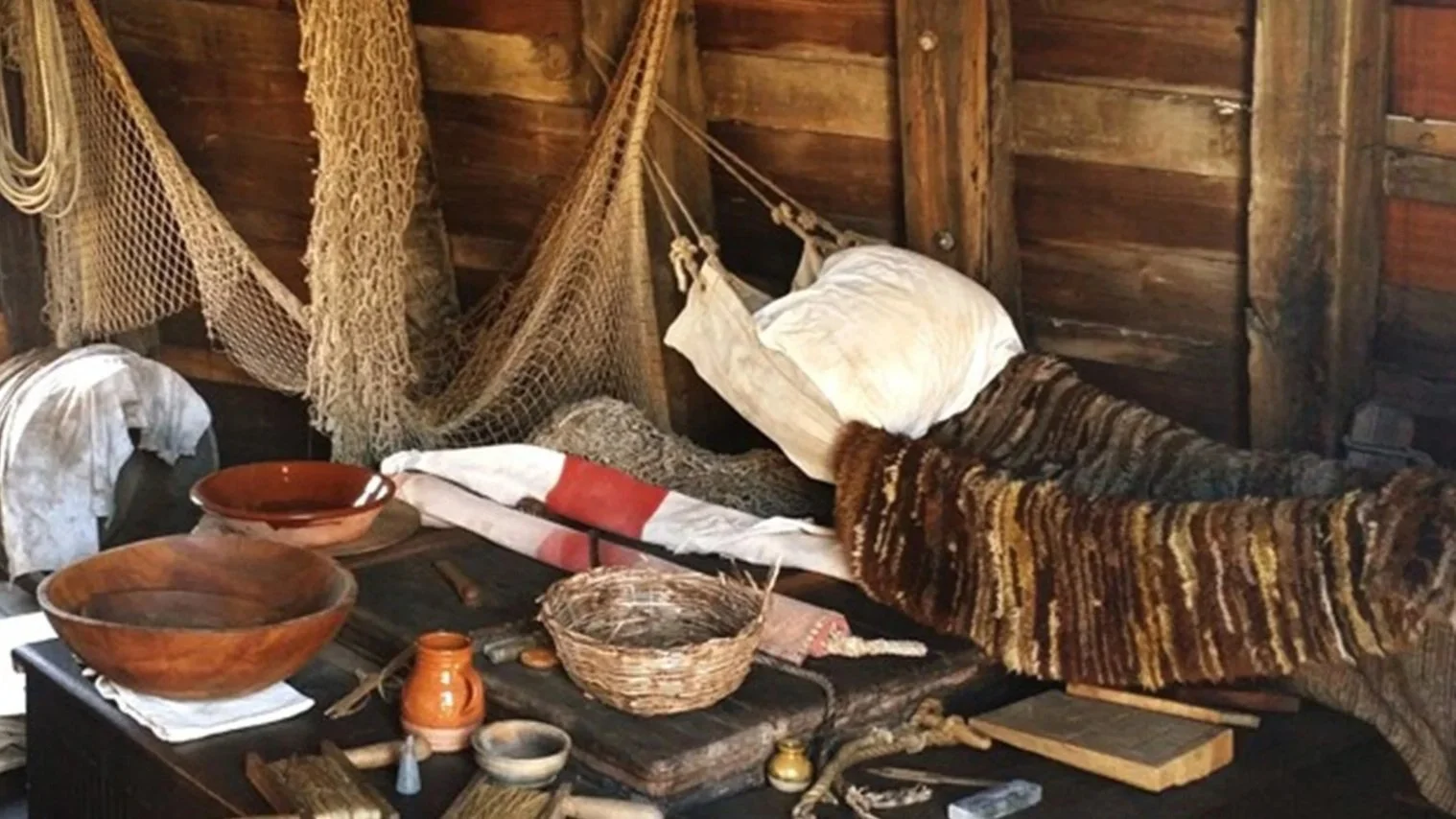
Among the 102 passengers that boarded the Mayflower on that fateful day on September 6, 1620 were eighteen women, including three valiant women who were pregnant, and thirty children under the age of eighteen. The ship’s thirty seven man crew ---sailors, cooks, carpenters, surgeons and officers were housed in small cabins above the main deck, while the Pilgrims were consigned to a suffocating, windowless space between the main deck and the cargo hold below.
In its second month at sea, the Mayflower encountered the first of an unrelenting series of storms that buffeted and battered the ship for weeks. At times the crew was forced to lower the sails and let the Mayflower bob helplessly in the towering waves. The lumber creaked, the mortar leaked, and the drenched, storm tossed passengers suffered from crippling bouts of seasickness.
[Image: Replica of Inside the Mayflower ]
Miraculously, all but one of the Mayflower’s passengers survived the grueling 66-day ordeal. A young, indentured servant named William Butten who was ill during most of the journey, died just three days before the New England coastline was sighted. There was one bright moment: midway through the harrowing voyage Elizabeth Hopkins gave birth to a baby aptly names Oceanus.
The oldest passenger on the Mayflower was a 64 year old tailor named James Chilton. James was born in Kent, England in 1555. Records show that from 1584 to 1600, James was charged and fined several times for offenses ranging from selling food and drink without a license to beating a man with a stick. He married in about 1586 to a woman who is known to history only as Mrs. James Chilton. They had ten children between 1587 to 1607 only three of whom, all daughters, survived to adulthood.
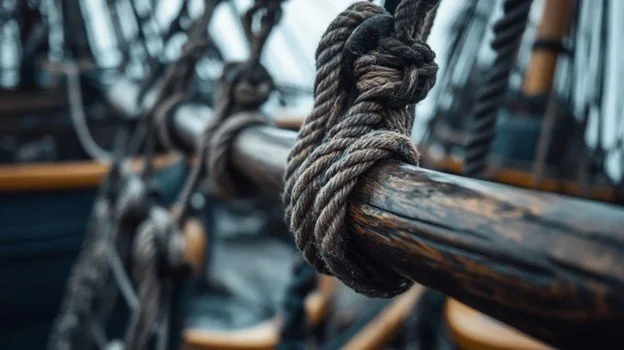
[Image: Rigging aboard the Mayflower]
In 1609, Mrs. Chilton was among four people that secretly buried a dead child, without the Church of England’s mandatory burial rites. For this act of defiance she was excommunicated, prompting the family to emigrate to Leiden, Holland to join the Pilgrim Separatists. In the spring of 1619, Chilton's house in Leiden became the scene of a small riot, due to a case of mistaken identity. Shortly after Chilton returned home from church, about twenty boys assembled and began throwing things at his house, shouting that Armenians (religious followers of Jacobus Arminius) were meeting there. When James confronted the crowd, he was struck on the head by a large cobblestone, knocked unconscious and needed the aid of a surgeon. A year later he was off to the New World seeking greener pastures.
When James Chilton boarded the Mayflower he was accompanied by his wife and thirteen year old daughter, Mary. The Chiltons left two of their children behind. Their daughter Ingle married Robert Nelsen in 1622 and no further record of her exists. Their daughter Isabella married Roger Chandler in 1615 and in 1630 the couple arrived in Plymouth with their two children. Mary Chilton is my genealogical connection to the Mayflower.
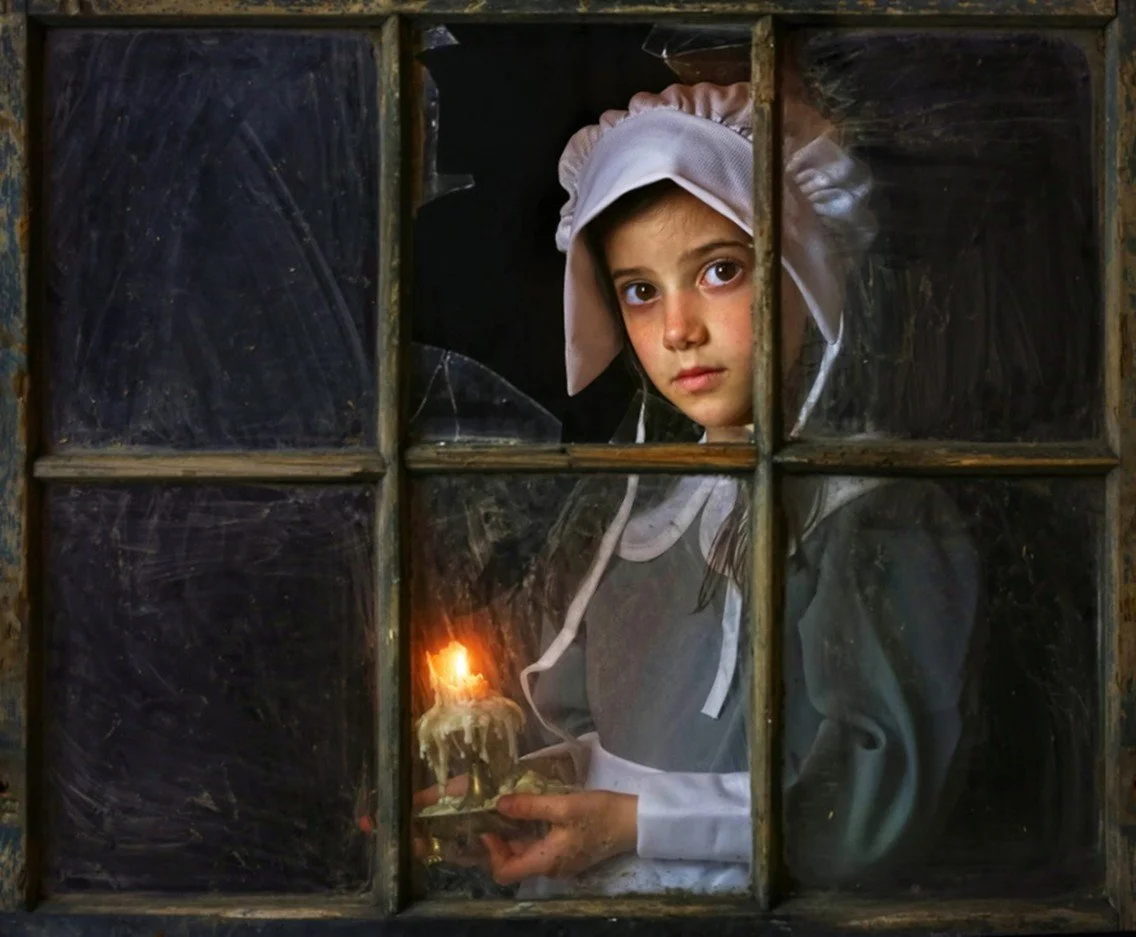
[Image: Painting of Young Pilgrim, artist unknown]
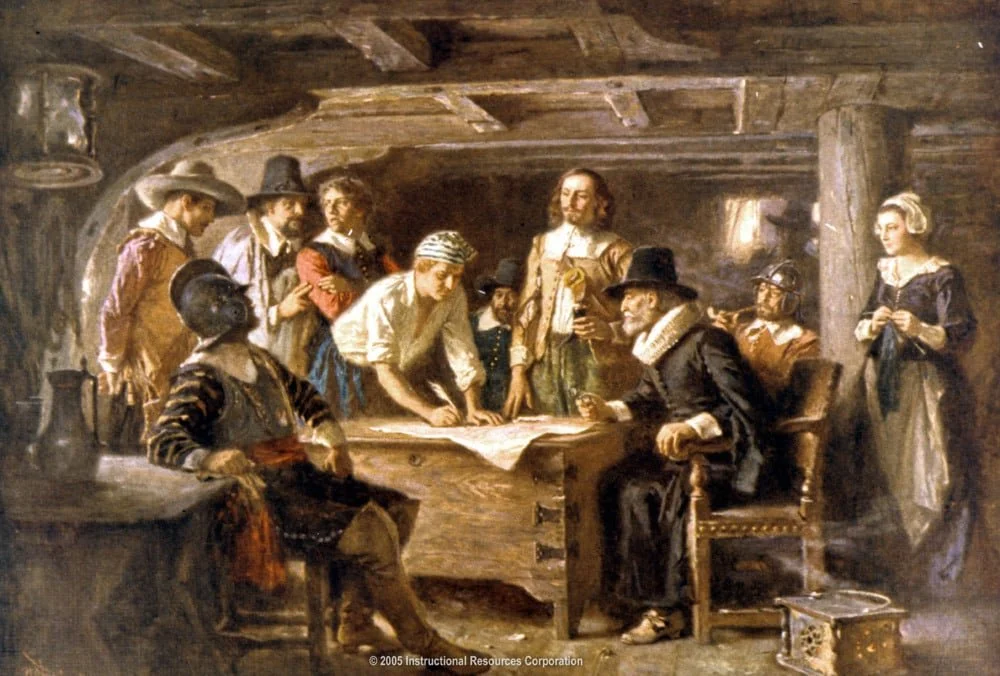
The Mayflower dropped anchor in Provincetown Harbor on the tip of Cape Cod in November of 1620. While in port, John Carver drafted the “Mayflower Compact.” This remarkable document is thought to be the first purely democratic government ever produced. It set forth the idealistic notion of being governed by the consent of the governed. It was signed by 41 adult males and surprisingly two indentured servants. James Chilton was one of the signers, but he died of “the infection” on December 8, 1620 while on board ship in that harbor without ever setting foot in the New World.
[Image: Painting “The Signing the Mayflower Compact” by Jeon Leon Gerome]
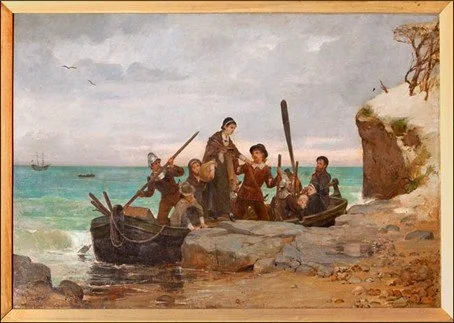
The Pilgrims remained in Provincetown for five weeks but got into a skirmish with the Nauset tribe of Native Americans and decided it was time to move on to a more hospitable location. Mrs. Chilton and her daughter Mary traveled on to Plymouth Harbor. Popular legend assigns Mary the distinction of being the first female to step ashore at Plymouth. Some historians embellish this story by saying that in her excitement to finally arrive, she leapt from the rowboat and waded to shore. Having experienced winters in chilly Massachusetts, I have good reason to doubt this “splashing through the water” version of the story.
[Image: The Land of the Pilgrims by Henry Bacon 1877 depicts Mary Chilton stepping on Plymouth Rock]
After several expeditions, a suitable location was located for the settlement. Much of the area had already been cleared for planting crops by the Patuxet Indians who had been conveniently wiped out by plagues between 1616 and 1619. In his diaries William Bradford wrote that bones of the dead were clearly evident in many places.
When the exploring party returned home, William learned that his wife Dorothy had fallen off the deck of the Mayflower and drowned in the icy waters in the bay. Historians speculate that it may have been a suicide – “the traumatic voyage, being surrounded by death and dying, the despair and depression she must have felt without their five year old son whom they had left behind in Europe” may have all been too much for her. Afterall, if John Howland could survive a fall in a torrential ocean storm how could Dorothy drown in calm bay waters? Another account claims the suicide was related to an affair with the ship’s Captain, Christopher Jones. The official record says her death was an accident. In his diary under death, her husband wrote simply; “Dec. 7 Dorothy, Wife to Mr. William Bradford.”
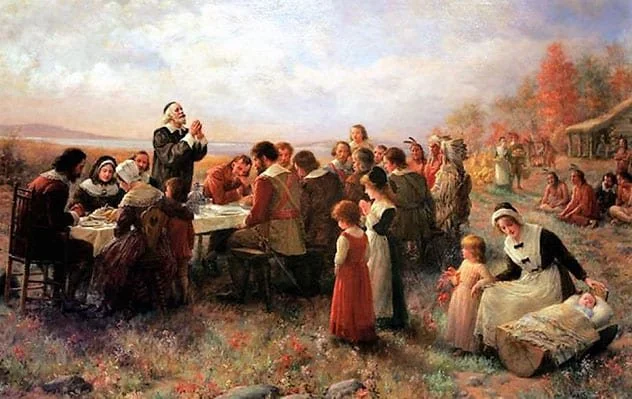
While the settlement was being built, the passengers continued to live on the Mayflower. Disease was rampant. Before the winter was over, half of the passengers had died including the sea-born infant Oceanus. Mrs. Chilton also died that dreadful winter, only six weeks after her husband, leaving Mary an orphan. When spring finally arrived only four of the eighteen women that boarded the Mayflower were alive and half of the surviving colonists were children under the age of 18. These four women - Elinor Billington, Mary Brewster, Elizabeth Hopkins and Susanna White (Winslow) - would have been the ones who prepared that famous first Thanksgiving feast in the fall of 1621. They were assisted by five surviving teenage girls. Mary Chilton would have been among them. Please remember to raise a glass to our ancestor Mary when you sit down each year for your Thanksgiving feast!
The painting on the left underestimates the magnitude of this well-known gathering. According to Edwards Winslow’s journal, the feast included the 52 surviving colonists and 90 Massasoit Indians “whom for three days we entertained and feasted.”
[Image: The First Thanksgiving at Plymouth Rock by Jennie Brownscombe in 1914]
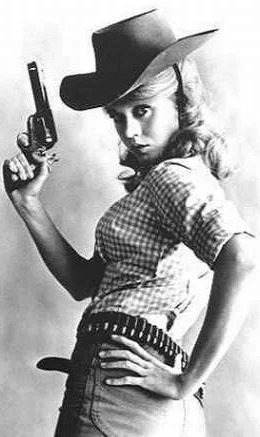
We owe these four surviving women a debt of gratitude. Thanks to Elinor Billington, children of the world now enjoy the works of Walt Disney. At one point spunky Elinor was roped to the stocks and whipped for slandering a church deacon. (Three thumbs down for her husband John for being the first convicted murderer in the New World for gunning down John Newcomen.) Thanks to Mary Brewster the world has Julia Child and Katherine Hepburn. Elizabeth Hopkins, who gave birth to the first baby at sea, made Norman Rockwell possible. Susanna White, who gave birth to the second baby in the Colony, brought us Humphrey Bogart. And I am delighted to report that thanks to Mary Chilton we have feisty feminist Jane Fonda. And me!
[Image: Jane Fonda in Cat Ballou “They’ll never make her cry…”]
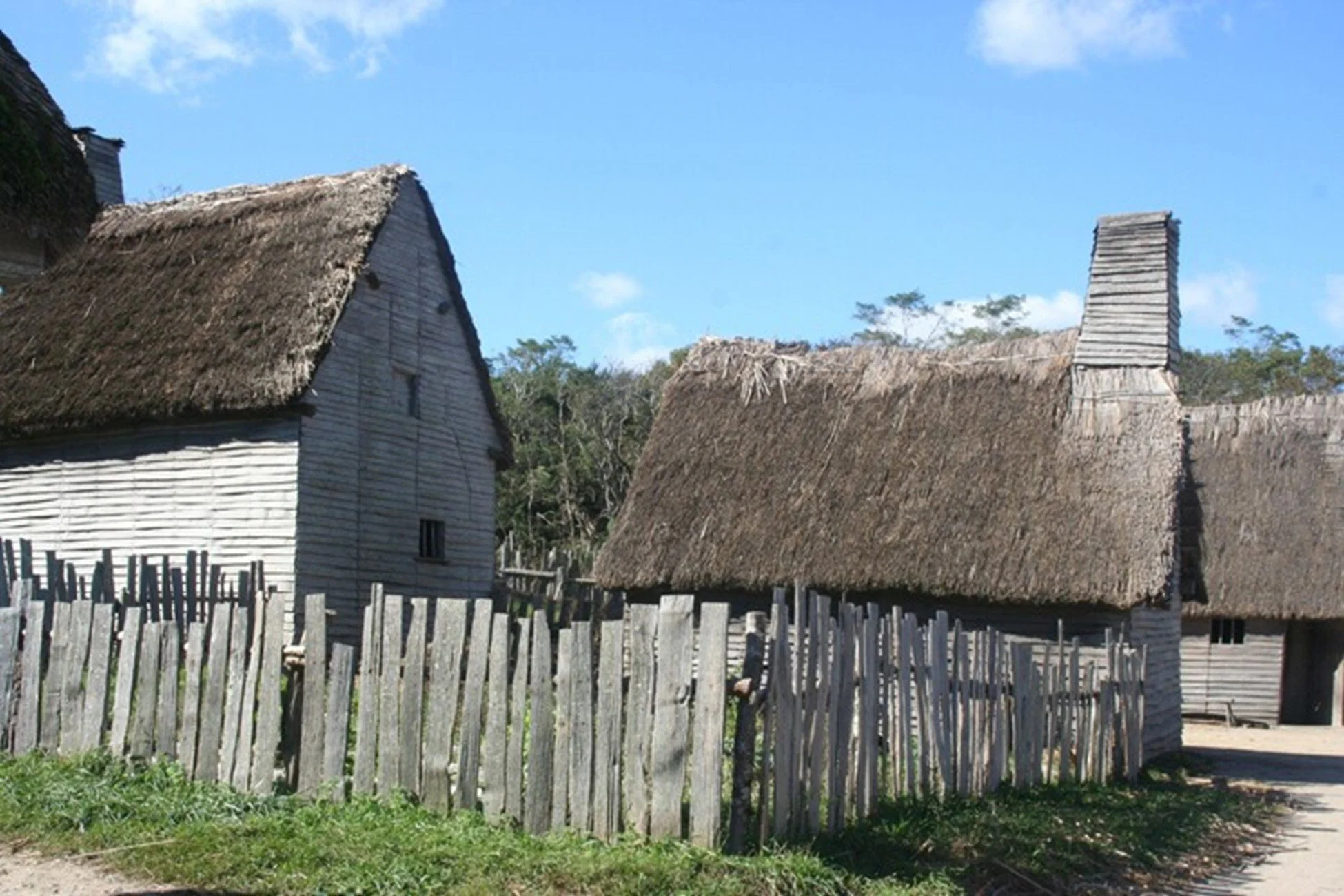
In 1623 the Pilgrims divided up their land. To be eligible you had to have arrived on the Mayflower, the Fortune (1621), the Anne (1623), or the smaller mostly cargo ships the Swan (1622) and the Little James (1623). Mary Chilton at the age of sixteen received three acres – one acre for each of her deceased parents and one for herself. Her land was sandwiched between the renowned John Alden and Myles Standish.
[Image: Plymouth Colony Living Museum Today]

Edward Winslow arrived on the Mayflower in 1620. His brother John arrived on the Fortune in 1621. Edward’s wife Elizabeth died the first winter in Plymouth and six weeks later Edward married the recently widowed Susanna White. Theirs was the first exchange of marital vows in the colony. The Winslow family was deeply involved in all aspects of the Plymouth Colony and made their mark on New England history. No known portraits exist for brother John Winslow, but quite a few exist for Edward.
John Winslow married Mary Chilton in 1626 and together they produced ten children. Their second child, Susanna Winslow, who was born in 1630, is my ancestor. In 1653 after the birth of their last child Benjamin, the family moved to the Boston Massachusetts Bay Colony where John became a prosperous merchant and ship owner. At the time of his death in May of 1674 he was one of the wealthiest merchants in Boston. Mary died five years later in 1679. Both John and Mary are buried in the famous King's Chapel Burying Ground in Boston.
[Image: Edward Winslow, three times Governor, brother of John Winslow]
Susanna Winslow, the daughter of John and Mary Chilton Winslow, married Robert Latham in 1649 in Plymouth County. In 1643 Robert was a Constable in Marshfield. Between 1650 and 1672 Susanna gave birth to nine children. Their first child was named Mercy and as you will soon find out her name was an ironic choice. Their fourth child, James Latham, my ancestor, was born in 1659. Here’s where the story takes a nasty turn.
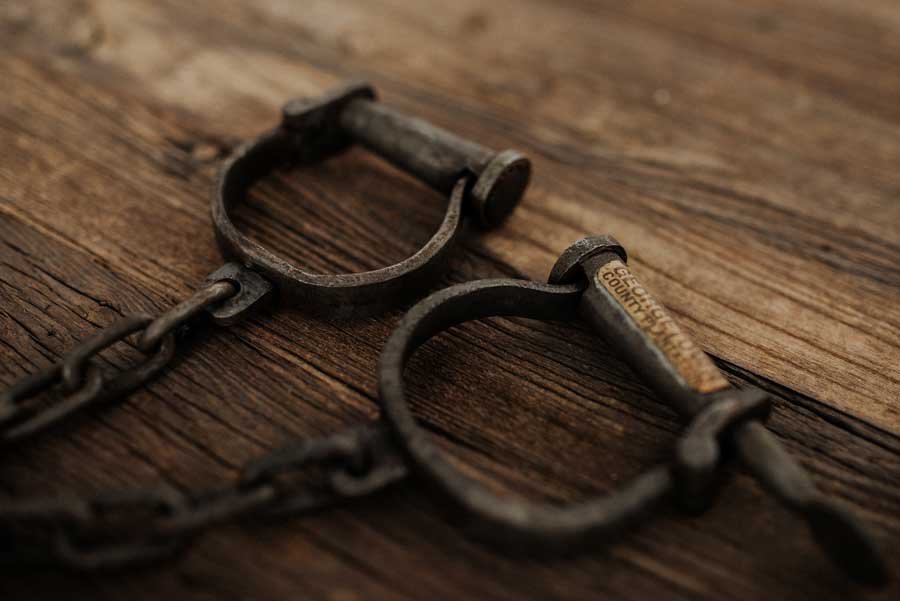
In 1654 Robert and Susanna were accused of felonious cruelty in the death of their fourteen year old servant, John Walker. The circumstances surrounding his death were quite gruesome. The boy had been starved, beaten, under clothed, and housed in extreme cold conditions. His corpse has holes where he had been injured when being forced to carry a log that was too heavy for him to bear. His hands and feet were frozen; his sad little body scarred from numerous beatings. The court found Robert guilty, and his punishment was the branding of his hand with a hot poker and the confiscation of all of his property. Susanna was charged but perhaps due to family connections, the court chose not to follow up on her prosecution.
In 1665 the family moved to the Bridgewater area. In 1679 Robert was fined twice for drunkenness. Susannah died between 1676 and 1683, followed by her husband in 1688. Some genealogists believe that Robert Latham was the son of William Latham, who arrived in the New World on the Mayflower at the same time as Mary Chilton.
[Image: Slavery Chains]
The Sad Story of William Latham (1609-1646)
When he boarded the Mayflower, William Latham was only eleven years old. He was one of six servants including a six year old boy named Jaspar More, indentured to John Carver. All three of Jaspar’s other siblings were also servants on the Mayflower. Their father Samuel More was obsessed with the idea that his wife Katherine had committed adultery and that his four children did not belong to him. To punish his wife and rid himself of the children, he arranged for them to be banished to the New World. His eight year old daughter Elizabeth More was a servant of Edward Winslow, his six year old son Richard and four year old daughter Mary were indentured to William Brewster. Richard was the only one of the four siblings that lived through the first winter in Plymouth.
William Latham also managed to survive the “Great Sickness” that devastated the Colony. His master John Carver, the first Governor of Plymouth Colony and a wealthy man who funded a significant part of the voyage, was not so lucky. He died In April of 1621 followed five weeks later by his wife Katherine. Little William was handed over to the William Bradford family to complete the rest of his seven year indentured servant contract. After finishing his term he lived alone and struggled financially.
When William Latham was 29 he was fined by the Plymouth court for “lavish and slanderous speeches” and for entertaining John Phillips in his house against the wishes of the court. I don’t know what all the brouhaha was about, but he was given a large fine that took him a year to pay off. When it was finally paid in 1639, he resettled in Marblehead in the Massachusetts Bay Colony to begin life anew.
In about 1643 William allegedly married an eighteen year old girl named Mary. She had been spurned by the young man she loved and vowed to marry the first man that came along. She was not in love with William, and not long after the wedding she began to engage in extramarital affairs with men who plied her with wine and gifts. One of her lovers, James Britton, confessed his affair with her, setting in motion a dreadful chain of events. Mary and James were both arrested. Mary admitted she had no affection for her husband whom she claimed was “an ancient man of neither honesty nor ability”, and that she had frequently abused him by “setting a knife to his throat and threatening to kill him.” She also named a dozen other men, including two that were married, that she had been with. Five of the men were rounded up but the accusations were not proven, and the men were released. The Court was clearly outraged by her behavior because it sentenced both Mary and James to death by hanging. The sentence was carried out in March 1644. Their story ended with the only known execution in America for adultery.
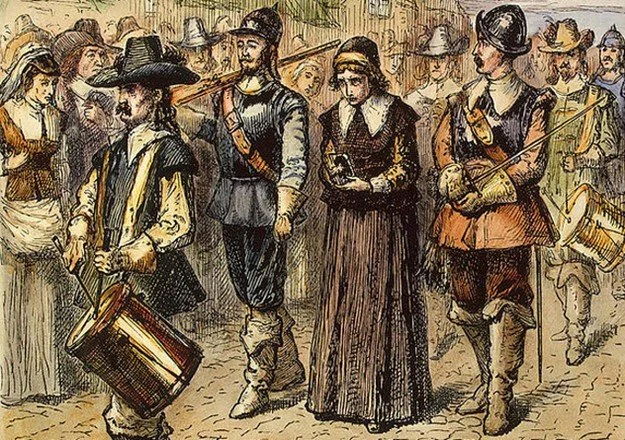
[Image: The Walk of Shame to the Scaffold]
According to an eyewitness account by Governor John Winthrop:
“The woman proved very penitent and had deep apprehension of the foulness of her sin, and at length attained to hope of pardon by the blood of Christ and was willing to die in satisfaction to justice. The man also was very much cast down for his sins, but was loath to die, and petitioned the general court for his life, but they would not grant it. They were both executed, they both died very penitently, especially the woman, who had some comfortable hope of pardon of her sin and gave good exhortation to all young maids to be obedient to their parents, and to take heed of evil company."
To me clearly John Winthrop’s commentary was a very deliberate rewriting of history to provide a lesson to the rest of the Colony.
In October of 1645 William Latham filed a complaint against John and Ann Baker who had “accidentally” burned down his house. That may have been the final straw because William returned to England and got involved with a group of adventurers headed by William Sayles. The group traveled to the Bahamas. The Colony failed and William along with all other members of the expedition starved to death. Thus, ending the troubled life of poor William.
The story of William and Mary makes for a very juicy story and fodder for discussion about woman’s rights and the undue harshness of puritan justice. However, genealogists who think Robert was the son of William are mistaken. Robert Latham was born in 1623, and William would have been only fourteen years old that year - too young to be Robert’s father. And in 1643 at age 34 too young to be the “ancient husband” that Mary described in her testimony. Genealogist latch on to the William/Robert connection because there were no other passengers named Latham that arrived in Massachusetts from 1620 to 1623. However, there was a Robert Latham that arrived in Jamestown in 1624 on “The George” with his parents Nicolas Latham (1575-1640) and Elizabeth Newman Latham (1579-1627). It seems highly likely that this Robert migrated north to the Mass Bay Colony to marry Susanna Winslow. It is also likely that Robert may have had a brother named Cary (1613-1685) who married Elizabeth Masters.
James Latham (1659-1738)
James Latham, the son of the scandalous Robert Latham and Susanna Winslow, was born in Marshfield in Plymouth Colony in 1659. He married Deliverance Alger about 1691. Together they had five children, one of whom, Thomas Latham, is my ancestor. James died in February of 1738 at the age of 80.
Thomas Latham (1693-1769)
Thomas Latham, the son of James and Deliverance Alger, was born in 1693 in East Bridgewater Plymouth. He married Deborah Hardin in 1712. Together they had ten children, one of whom James was born in February of 1736. Thomas died in 1769 at the age of 92.
James Latham (1736-1785)
James Latham, the son of Thomas and Deborah Hardin, was born in 1736. He married Agnes Hardin in 1761 in Pitt County North Carolina. Their first child was a girl named Rebecca. She was followed by four sons who carried family names: Thomas was named for James’ father, John and Rotheus for his brothers and James Jr for himself and his grandfather. James and Agnes’ sixth and last child, Major Alexander, does not appear to have a family name connection.
Nonetheless, Major Alexander Latham is my ancestor. Brothers Rotheus, James Jr, Thomas and Major Alexander appear as heads of families and owners of enslaved persons in the US Census of 1800 in Beaufort North Carolina on the same page. Their father James Sr died in 1785 in Beaufort at the age of 49. Their mother Agnes Hardin Latham died in 1818 at the age of 78.
Major Alexander Latham (1779-1821)
Major Alexander Latham, the son of James Latham and Agnes Hardin, was born in 1779. He married Agnes Perkins. I initially thought that Major was a military title but the only evidence I found was an Alexander Latham who fought in the War of 1812 as a Quarter Master. It finally occurred to me that Major is also a man’s name. (Some of you may recall the amusing fictional character in the movie Catch-22 who was named Major Major Major as a joke by his father.) Major had six children one of whom, Sarah Ann Latham, is my ancestor. Major was granted a 50 acre tract of land in 1799 on the banks of Tranter’s Creek in Beaufort North Carolina, and it was there he built his plantation house. The US Census in 1810 reports him living on the plantation with his wife, four daughters under the age of ten and nine slaves. Soon after this census Major had two sons. He died in 1821 at the age of 42 years. His will does not mention his wife so she must have predeceased him. When his will was probated in 1823 his Tranter’s Creek property was divided among his three daughters: Sophie Elizabeth and her husband John Watkins Williams, Sally Ann Latham, Margaret Latham and his two sons: Dempsey Latham and Wyriett Latham.
Sarah “Sallie” Ann Latham (1803-1882)
Much of what I discovered about the Latham family came from a scholarly 400 page genealogy book published in 1994 by Thomas Topping called “Topping/Latham Family History.” It meticulously traces the lineage from James Chilton through Major Alexander Latham and is extensively quoted in Ancestry.com. Topping mentions Major’s five children by name but does not provide much information about them. Much of what I discovered about the Ricks family came from a scholarly 700 page genealogy book, “History and Genealogy of the Ricks Family,” written in 1957. The book had been owned by my Aunt Martha. In this book I learned that my ancestor, Thomas Little Ricks, married a woman by the name of Sarah Ann Latham who was born on January 9, 1803 in Beaufort, North Carolina. Their first child was born in 1824. Topping said Major’s daughter was named Sally not Sarah and that Sally died in 1823. I thought I had reached a dead end. However, the more I dug the more I was convinced that Sarah and Sally were the same person, and that not only did she not die in 1823, but that she is my connection to the Mayflower.
First, the name Sallie was commonly used as a nickname for the name Sarah. It would not be unusual for her father to use her nickname in his will.
Second, the names Sarah chose for her children mirror the one’s in Major Alexander Latham’s family. One of Sarah’s sons was named John Watkins Williams Ricks, the exact same name as her sister Sophie’s husband. One of Sarah’s daughters was named Margaret after her other sister.
Third, in the US Census in 1830 and 1840 Thomas L Ricks, Sarah’s husband, was listed as the head of the family on Tranter’s Creek in Beaufort North Carolina. Tranter’s Creek was where Major Alexander Latham was granted property and at probate this land was distributed to his children.
Fourth, census data is not listed alphabetically. It lists inhabitants in the order of where their house is located. In the 1850 census, 47 year old Sarah Ricks and six of her children were living right next door to her cousin Alfred Latham and his children on Tranter’s Creek. Alfred was the son of James Latham Jr, her father’s brother. In the 1860 census Sarah Ricks lived with her son Benjamin Ricks on Tranter’s Creek. Still living right next door to her, was Alfred Latham and Alfred’s son D P Latham had his own land along the creek next to them.
Lastly, in the 1880 US census 77 year old Sarah Ricks was still living with her son Benjamin, and in that census she used her nickname “Sallie.”
No doubt in my mind, Sarah Ann (“Sallie”) Latham is our link to the Mayflower. Sallie was the great grandmother of Francis L Ricks. Francis Ricks’ story can be found in a separate blog. To summarize the genealogy trail from Sallie Latham to the present:
The Ricks Family
Sarah Ann ( “Sallie”) Latham, the daughter of Major Alexander Latham and Agnes Hardin was born January 9, 1803 in Beaufort County North Carolina. She married Thomas Little Ricks in 1824. Together they had ten children one of whom, Robert Van Buren Ricks, is my ancestor. Sarah Ann died at the age of 79 years on February 15, 1882.
Robert Van Buren Ricks, the son of Thomas Little Ricks and Sarah Ann Latham was born June 13, 1835 in Beaufort County North Carolina. He married Winifred Louise Leggett in 1866. Together they had ten children, one of whom, Thomas Blount Ricks, is my ancestor. Robert Van Buren Ricks died on May 20, 1887 at the age of 52.
Thomas Blount Ricks, the son of Robert Van Buren and Winifred Leggett, was born in 1870 in Pitt County North Carolina. He married Margaret Langley in 1895 and together they had seven children one of whom, Frances L. Ricks, is my paternal grandmother. Thomas Blount Ricks died on March 12,1943 at the age of 73.
Frances L Ricks, the daughter of Thomas Blount Ricks and Margaret Little Langley, was born August 4, 1904 in Washington North Carolina. She married John Edward Cobb, Sr and together they had three children one of whom, John Edward Cobb Jr, is my father. Grandma Fannie died in 1982 in St. Stephen South Carolina at the age of 78.
And there we have it. Mary Chilton is my ninth great grandmother.
