The Ricks Family

The name Ricks is thought to be of Germanic origin and its first appearance in England was about 1066 - the time of William the Conqueror. Spellings of names changed over time; names were recorded phonetically based on the interpretation (and literacy) of the person who recorded them, and they got anglicized upon arrival in a new country. Sometimes Ricks is also spelled Rickesis, Rickes, Rixe, and Rix. For consistency, I used the spelling “Ricks.”
[Photo: Quaker couple in the mid-1800s]
The presence of a family crest is a testament to a families’ status and influence and is associated with noble titles, wealth and historical significance. I don’t know what the Ricks family did to deserve one, but for what it is worth, here is their family crest:

[Photo: Ricks Family Crest]
According to the author of a 700 page genealogy gem called “History and Genealogy of the Ricks Family of America,” this crest can be found in the mosaic floor of the church at the Brancaster Castle (circa 1525), the Ricks family ancestral home in Norfolk County, England. If you watched Downton Abbey you might recognize this stunning photo:
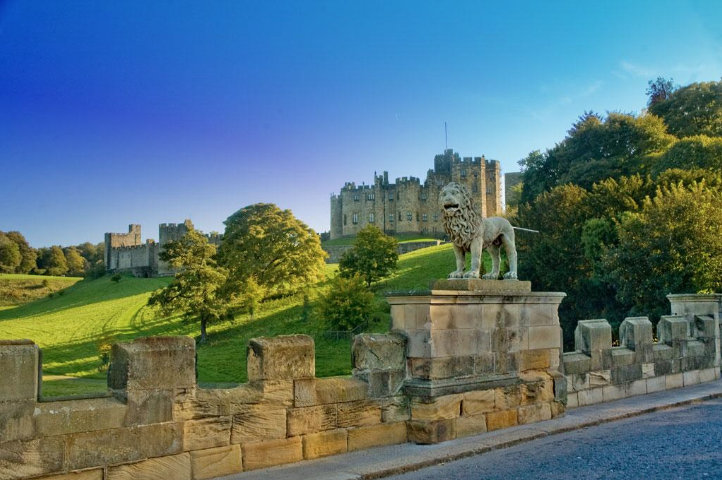
This castle is referred to as “Brancaster Castle” in the film, but sadly when things seem too good to be true, they often aren’t. This magnificent property is actually Alnwick Castle, the 2nd largest owner occupied castle in England. This castle was used as a setting for many other well-known films including Hogwarts in the Harry Potter movies. Alnwick is a huge tourist attraction and for a fee you can even take “broomstick flying classes.” It appears that Duke and Duchess Percy need a little help with the upkeep of the premises.
My internet search uncovered a village called Brancaster. It’s a lovely little fishing village with 797 residents.
The village’s name means “Roman site of Branodunum.” Nearby is the ruins of an ancient Roman fort from the 5th century most of which was destroyed during the construction of a locally opposed housing development in the 1970s. (Humans can be such foolish creatures). Sadly, no mention of a castle in my hunt. Maybe, the Ricks lived in the fort??
[Photo: One of the castles where Downton Abbey was filmed]

Isaac Ricks (spelled Rickesis in early accounts), my 8th great grandfather, was born in England in 1638 and died at the age of 85 in 1732. He immigrated to America and settled in a place called Chuckatuck on the Nansemond River in Isle of Wight, Virginia. According to old church records from the Chuckatuck Friends Meeting Place, his wife was named Kathren and they had a son, our ancestor, named Isaac Jr in 1669. They also had eight additional sons: William (1670), John (1672), Abraham (1674), Jacob (1677), Robert (1679), Benjamin(1682), Richard (1684) and James (1690); a daughter named Kathren after her mother who only lived for two months (1684), and another daughter named Jeanne (1687). In 1702 Abraham and Robert built the Chuckatuck Church in exchange for 32,000 pounds of tobacco (the currency of the time.) Prior to the building of the church the “Friends” (commonly known as Quakers) met in each other’s homes. The church was abandoned and “laid down” in 1769 because religious persecution forced large numbers of Quakers to relocate to North Carolina.
[Photo: Brancaster, Norfolk England]
Persecution was not new to the Quakers. It had begun long before in England prompting their immigration to America. The Quaker movement began in England in the 1640’s. Its founder, George Fox, believed that every individual could experience the “inner light” of communication with God without the need for clergy or formal rituals.
His teachings were contrary to the established Church of England as well as anti-military and his converts were subject to violent persecution. When Puritans arrived in New England they brought their deep seated hatred of Quakers with them. Beginning in 1656, laws forbade any captain to land Quakers in Massachusetts. Fines were exacted for anyone providing food and shelter to them.
If they dared to come ashore Quakers were “to be severely whipped on his or her entrance and kept constantly at work and none were suffered to speak to them.” Quakers were publicly flogged, had their ears cut off and their tongues bored through with hot irons. In some cases in Boston the death penalty was exacted.
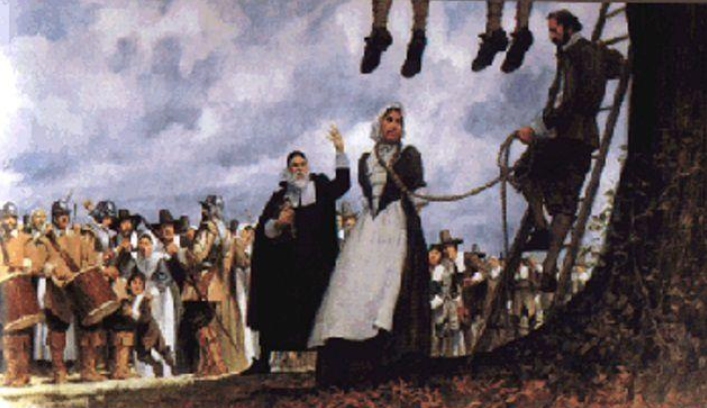
The first Quakers arrived in Virginia in the 1650’s. Elizabeth Harris, one of Fox’s missionaries, founded settlements of Friends along the James River and the movement spread to the Isle of Wight and Lower Norfolk Counties. Since Virginia Quakers, like their New England brethren, flouted civil disobedience the magistrates became increasingly hostile to them. The first documented arrest of a Virginia Quaker missionary was William Robinson, who was charged with “denying the humanity of Christ” and being a “seducer of people to faction.” He returned to Massachusetts, and in 1659 was hanged from an Elm tree in the Boston Commons with other Quakers for daring to return from banishment and continuing to preach doctrines unacceptable to the Puritan leaders in Boston.
[Photo: Quakers executions in Boston Commons]
Virginia’s Governor, Sir William Beverly, fired off a steamy missive in 1663 to the “gentlemen” of the James River area enjoining them to use every effort “to root out ye abdominal seed of ye Quakers.” Their refusal to remove their hats in public, swear oaths, or pay tithes to the Anglican church led to their imprisonment and property confiscation. Laws were passed requiring baptism of children according to Anglican church practices, making everyone over 16 to attend Anglican church services, and imposing a fine of 200 pounds of tobacco on anyone attending a Quaker service. Virginia officials refused to accept Quaker marriages as legal. Couples who chose to wed in the presence of God but without the services of an Anglican minister were accused of fornication (with fines as high as 500 pounds of tobacco and imprisonment) as late as 1690.
Quakers are the forerunners of the movement for social justice. They were early advocates for the abolition of slavery, women’s rights, and the right to refuse military service. They were among the first religious groups to recognize same-sex marriages. For such a relatively small group (only 75,000 members in the US today) they certainly have had a big social impact.
Isaac Ricks, the immigrant, and his family appear to have been regularly active in their Quaker church. Based on the political climate at the time they must have experienced some of the negative consequences of their choice of religion. Isaac Sr and his wife died in Virginia, but it is telling that their son Issac Jr ultimately chose to move to North Carolina.
Isaac Ricks Jr, my 7th great grandfather, married Sarah McKinnie, the daughter of Barnaby McKinnie of North Carolina, and in 1748 Isaac signed his will in Edgecombe County. He left his plantation to his son Abraham (after a life interest to his wife), 400 acres of land to his son Robert, 80 pounds of Virginia currency to his son John; enslaved persons, furniture, household goods and livestock were allocated among these three sons and two daughters. Interestingly, only his wife and Abraham are referred to as “my beloved” in the will, and he chose not include five of his sons, including my 6th great grandfather, Benjamin Ricks. The omission of his two oldest sons, William and Isaac III, might make sense. It appears William renounced Quakerism and was quite wealthy (his widow, Sarah his 2nd wife, mentions 50 to 60 enslaved persons in her will). His second oldest son Isaac III owned a successful grist mill on the Tar River and the land on which the present town of Rocky Mount now stands. His son Benjamin married Patience Healty and bought a 400 acre piece of land for 40 shillings in Lunenburg County Virginia, and was still living in Virginia when his father, Isaac II, died.
Benjamin Ricks moved to North Carolina in 1752 and bought a large tract of land from his brother William near Rocky Mount. Patience gave birth to ten sons, (one of whom, Thomas, is my ancestor), and three daughters. Unlike his older brothers, Benjamin was not a wealthy man. At his death in 1774 he left his wife 80 acres of land and he gave 5 shillings to each of his 12 children and left the remainder of his estate to his youngest son Abraham.
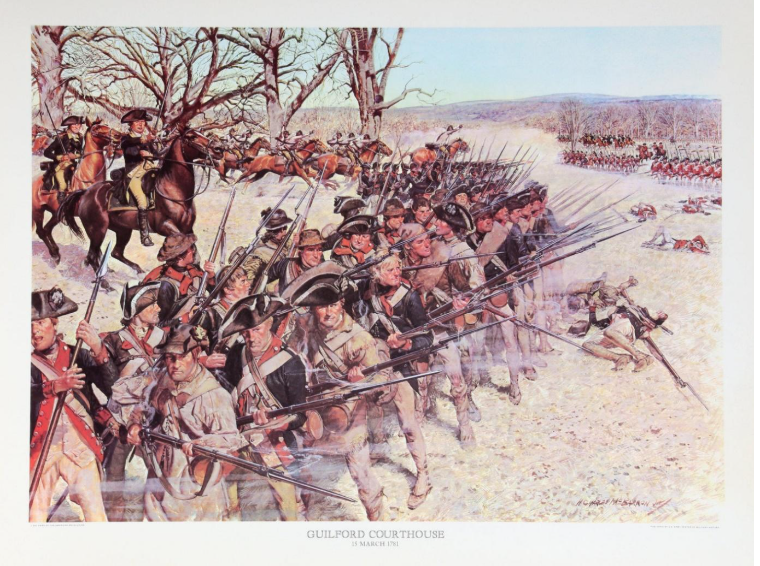
Benjamin’s son Meridith was a silversmith and was reported to be a miser. He never married and at his death in 1780; despite great efforts, mysteriously his money stash was never found. At least five of Benjamin Sr’s sons: Benjamin Jr, William, Lewis, John and Thomas, fought in the Revolutionary War. Benjamin Jr was a Sergeant Major in George Washington’s Continental Army. Two of his sons, William and Lewis, fought together at the bloody Battle of Guilford Courthouse on March 15, 1781. Lewis was drafted into the army as a private but was a devout Quaker and did not believe in shedding blood. William witnessed his brother drop his gun and go into battle without his weapon. That was the last time he saw him. Lewis’ heirs received a postmortem 200 acre land grant for his military service; perhaps the government was unaware he hadn’t actually fired a single bullet. Interestingly, most of these civil war land grants came from the confiscated property of Tories who fought for the British during the war.
[Photo: Paiing of Washington’s Army]
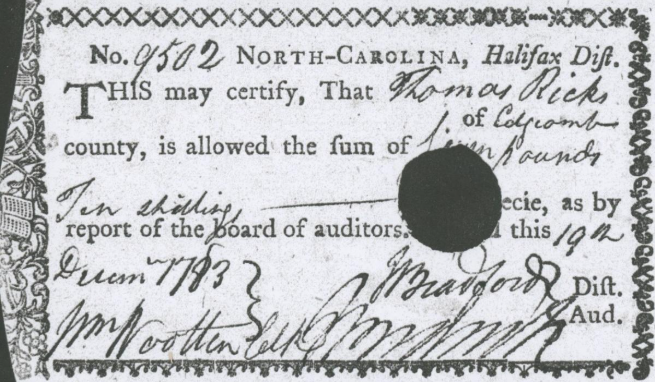
Thomas Ricks, my 5th great grandfather, was born in 1745 in Edgecombe. He married Priscilla Williams in 1775, the year that marked the beginning of the Revolutionary War. During the next 8 years 35,000 men between the ages of 16 and 60 from North Carolina joined the call to duty. Thomas was among them. At the war’s conclusion in 1783 he received his final military voucher that represented an “IOU” including interest for seven pounds 12 shillings for his effort. Privates in 1776 received the equivalent of a whopping $6 per month (about $158 in today’s dollars) plus a bounty at the end of their service. At the time, the promissory note was almost worthless and many speculators bought them cheaply from the rank and file before they left camp. Many soldiers sold the notes to pay for their way home to loved ones. One wonders if Thomas was ever able to exchange his for cash. I also found copies of similar pay vouchers for two of his brothers, William and John.
[Photo: Thomas Ricks’ Revolutionary Pay Voucher December 1783]
Thomas and Priscilla had two or three sons: Alexander (my ancestor), Urban and Wiley; and a daughter Milberry. Thomas passed away 15 hours after his will was drafted on September 13, 1789. Three of his brothers - Benjamin, Joel and Abraham - were by his side when he took his last breath. His estate was to be equally divided between “his wife Priscilla, his son Alexander Urban and his daughter Milberry.” His father in-law Roland Willliams and his brother Abraham were named executors. There is some contradiction in the records as to whether Thomas had one son named Alexander whose middle name was Urban, or whether he had two sons - one named Alexander and the other named Urban. But in any case, no matter what his middle name was, our ancestor is Alexander. Roland Williams referred to “the lawful begotten heirs of my daughter Priscilla” in his will dated 1813, so it is clear Thomas’ his wife predeceased her father. In his will Roland mentioned his son Urban which explains how the name came to be used with Thomas and Priscilla’s son.
Alexander Ricks my 4th great grandfather, was born in 1776 in Edgecombe County. His son, Thomas Little Ricks, was born in Nash County, North Carolina in 1802. The name of Alexander’s wife is not known. Thomas Little is my 3rd great grandfather. According to the same source (History and Genealogy of the Rick’s Family), Alexander’s brother Urban (born 1778) also had a son named Thomas (who married Archie Polin and then later Sally Taylor) and a son named Alexander. The name of Urban’s wife is not known.
Thomas Little Ricks married Sarah Ann Latham in 1824. Sarah is a descendant of Mary Chilton who came to America on the Mayflower. The story of the Mayflower and my family connection to it is covered in depth in another section. The couple settled in Tranter’s Creek in Beaufort County, North Carolina, where Sarah was from. By the 1830 census they had one daughter, Jane Amanda; two sons, William Alexander and Edward Thomas; and four enslaved persons. By the 1840 census the family had added five more sons: Benjamin Henry, John Watkins Williams, Robert Van Buren, James Churchill and Samuel Elisha; and the family had ceased using slave labor. Six years after the census was taken Samuel E. died at the age of eight. Sarah gave birth to one more daughter, Margaret Loveger, in 1842 and her last son, Harold Francis, was born in 1844. Margaret died at age three. Harold died before his 6th birthday. Jane Amanda married a farmer, William Carrow. She lived to be 81 years old. William Alexander, worked as a farm laborer, and died at the age of 22 of the measles in 1850. Edward Thomas moved to South Carolina, fought in the infantry in the Battle of Petersburg and was imprisoned as a POW in 1864 at the notorious Point Lookout in Maryland until his release in 1865. When John Watkins died without a will in 1893 his widow had to go to court and fight her children to get her “widow’s dower”. Robert Van Buren is my ancestor. By 1850 Sarah was a widow. Five of her sons lived with her as did a young eight year old girl named Mary P Latham. She owned one fifteen year old enslaved person. Despite the fact that all of Thomas and Sarah’s sons were farmers there is no record of any of her sons owning enslaved persons on the 1850 or 1860 census slave schedules. In the 1860 and 1870 census she lived with her son Benjamin and his family. In 1880 she lived with her grandson Jessie (Benjamin’s son) and his family. She died in 1882 in Beaufort County.
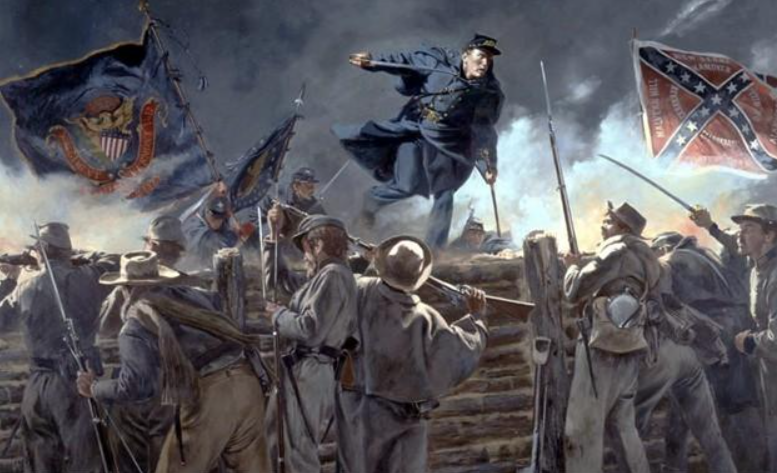
[Photo: The Battle of Petersburg]
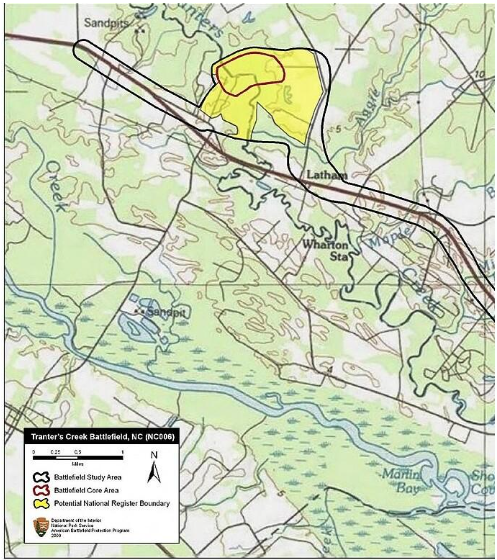
Robert Van Buren Ricks, my 2nd great grandfather, was born in 1837. It’s possible he was named for President Van Buren who took office in 1836. At age 24 in 1861 Robert married Winifred Louise Leggett, and the couple settled down to farming life together in Tranter’s Creek, Beaufort County. A year later he enlisted in the Confederate infantry as a private May 30,1862 and five days later Union forces advanced to Tranter’s Creek and a battle commenced. Blood was shed on both sides of Myer’s Bridge which spanned the creek. You’ll note that in close proximity to the battle (the red circle inside the yellow area on the map), is a village called Latham, which very likely was named after Robert’s mother’s family.
[Photo: Map of the Battle of Tranter’s Creek]
Robert was wounded in Richmond in June of 1863 and returned to battle two months later. A year later in May of 1864 he suffered a gunshot wound to his face, was captured and sent to a Union Hospital in Washington D.C. From there he was transferred to the horrific Elmira POW Camp (aka “Hellmira”) in New York where nearly 25% of the prisoners died from disease and malnutrition. A local entrepreneur named Nichols built a three story observation tower and charged 15 cents per view so the curious public could get a view of the imprisoned soldiers. Nichols reportedly made $5,000 before the commandant ordered the tower be taken down. Robert managed to survive and was finally released as part of a prisoners exchange in February of 1865. Five years after the war In the 1870 census his real estate and personal property were valued at a modest amount - $300. Between 1862 and 1885 they produced ten children, one of whom, Thomas Blount Ricks Sr is my ancestor.
Robert and Louise’s son, Robert Montford Ricks, a lumberman, died of heart failure at the age of 76 in 1938. Robert M had a son named Wiley. Wiley worked as a clerk in a local pharmacy in Louisville, Kentucky. Complaining he was tired of life, at the age of 31, he stepped behind the counter and guzzled down a bottle of morphine. Four hours later he was declared dead. Robert and Louise’s second son, James Fernandia, was a farrier (a craftsman who trims and hooves horses). He died of tuberculosis in 1919 at the age of 52. Their third son, Thomas Blount Sr is my great grandfather. Their fourth son, John Samuel, was a farmer. Their fifth son, Elmer Bunyan was a crane operator for a railroad worker and died of a fractured skull at the age of 67. Son number six, George Zeb, was a merchant and a farmer and died of senility and heart disease in a nursing home at the age of 94. Son number seven, Edward Henry, was a railroad millwright who died at age 69 of gastric carcinoma. Their last son Leon Dessanus was a merchant who died of a heart attack while on a deer hunt at the age of 65. Robert and Lousie also had two daughters: Ida Amanda who married and moved to Pennsylvania, and Laura Estelle who died at age eleven.
Robert Van Buren died in Beaufort County at the age of 52 in 1887. In 1920 census Louise lived with her son Samuel and his family. She died of heart failure at the age of 87 in 1930.
Their son, Thomas Blount Ricks Sr is my grandmother Fannie’s father. Their stories are discussed in another section.
