Nicholas Cobb (1611-1686)
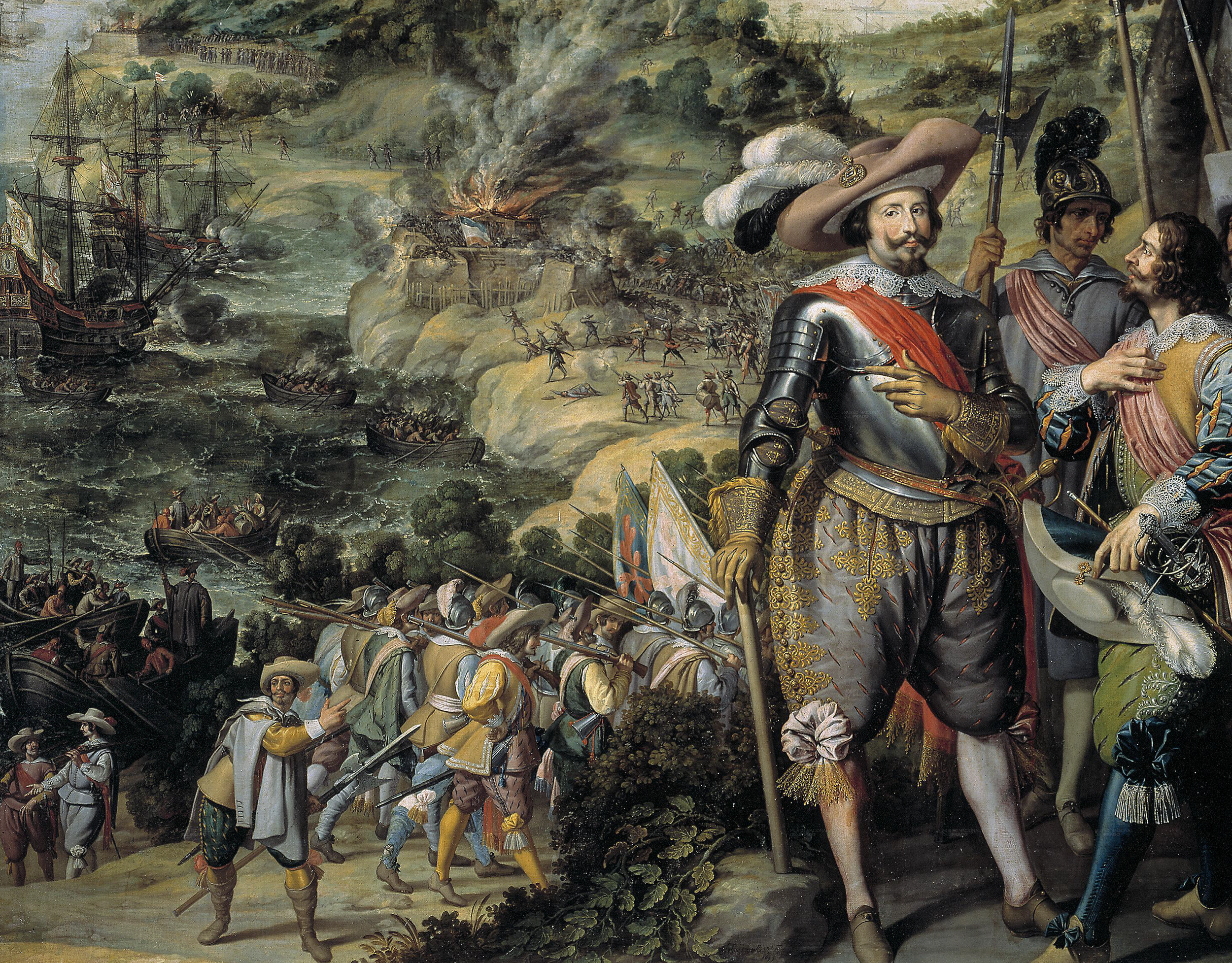
It was September of 1635. An ambitious 24 year old man named Nicholas Cobb stood on the dock in Gravesend, England preparing to board the ship, “William and John”, for the New World. Its first port of call was St Christopher’s Island (now known as St. Kitts) in the West Indies (now known as the Caribbean.) The tiny island was “discovered” and named after Christopher Columbus and the area called West Indies because Columbus thought he had reached the Indies (Asia) on his voyage to find a trading route. A century later the formerly peaceful island became a hot bed of contention among the sea powers of Europe.
[Painting: Spanish Fleet under Don Fadrique Alvarez de Toledo descended St Christopher’s Island in 1629]
The first English Colonywas established on the island in 1623, followed by the French, fresh from a sea battle with a Spanish warship two years later. The English and French joined forces to slaughter 2,000 local Kalinga people, enslave women, and forcibly remove the rest of the Kalinga people from their homeland. Four years later the Spanish destroyed all of the French and English settlements, took hostages back to Spain, and sent 600 poor souls to work the mines in Spanish America. English control returned in 1630 when the five year Anglo-Spanish war came to an end.

The island boasted exotic sugar and tobacco offering immense riches to planters, merchants in England, and the ship owners who delivered the products. When sugar planters in the West Indies began converting the waste products from sugar to produce rum, the island became even more valuable.
[Image: Sugar Cane Fields]

In 1635, the year that Nicholas set foot on the island, there were about 550 enslaved Africans on the island suffering in the scorching heat of the tobacco fields. When the Virginia Colony began to dominate world tobacco production, the economy in the West Indies collapsed. Many British tobacco plantation owners fled the islands for Virginia where land was relatively plentiful for those in a position to buy it. Others became buccaneers. The remaining planters rebelled against the government and their insurrection was brutally suppressed in 1642. It was hardly the idyllic island nestled in the Caribbean that we think of today.
[Painting: Slave Trade by George Moriland]
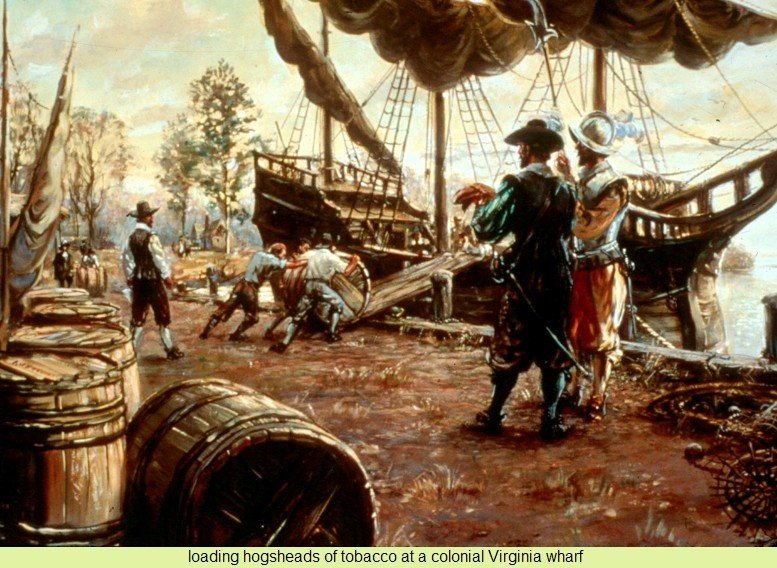
Despite the violent upheavals on the island, it was an important port of call for mariners who made their living traveling the seas between the West Indies and America and Europe to engage in international trade. Of the 104 men that set out for St Christopher’s Island in September of 1635 on the “William and John”, the names of 30 of them, including Nicholas Cobb, are listed in County Records in Virginia. The first known record of his life in Virginia was when Nicholas witnessed a transfer of land in 1656 in the Isle of Wight in Virginia. In March of 1659 he loaded four 1,000 pound “hogsheads” of tobacco in Virginia onto the ship the Speedwell which was bound for England.
Nicholas was a mariner most of his life. Life at sea at that time was notoriously difficult. Many sailors were conscripted to serve against their will and grossly mistreated. Paraphrasing a famous Samuel Johnson quote: “
If a man could choose between life as a sailor or life in jail, they would choose jail.... a man in a jail has more room, better food, commonly better company and no chance of drowning.”
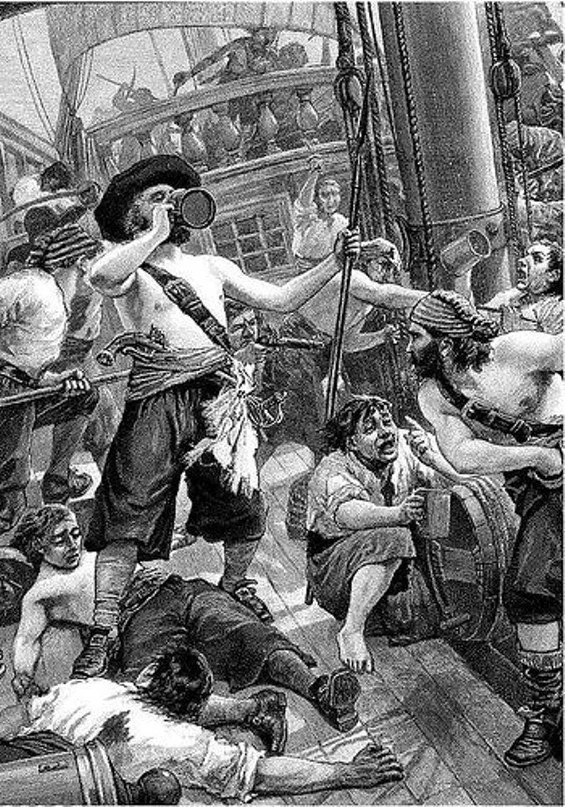
Images of cat-o-nine tail floggings, peg legs and rum soaked mischief comes to mind but much of that imagery comes from war ships and pirate ships. Sailors on merchant ships were there by choice and were paid relatively well, in some cases they were even shareholders. The major trading companies allowed some of its sailors to invest in the cargo so they would have a vested interest in the goods they carried. We don’t know what kind of cargo Nicholas transported but given his early connection to St. Christopher’s Island its possible that he may have been engaged in slave trade. In the mid-1650s the population of Virginia was about 15,000, 1,000 of whom were enslaved. There is no record of Nicholas bringing enslaved persons to Virginia, but I am willing to bet that in addition to tobacco that rum was part of his portfolio.
[Image: Sailors overindulging in some of their cargo]
Later in life Nicholas managed to stay off ships long enough to find a wife, Susan, and father three daughters: Mary (born about 1655), Susan (born 1657), and Jane (born 1659). After their third child was born, Nicholas made arrangements to bring his wife, daughters and a mystery woman named Jane Howard from Europe to Virginia. Jane Howard may have been his mother-in-law, sister in-law or perhaps a servant. No other record of this woman has surfaced to explain her connection to the family.
In February of 1663, utilizing his head rights from his family’s journey, Nicholas obtained 202 acres of land called “Little Neck” on Floyd Creek, issuing out of Pagan Creek in the Isle of Wight. His wife gave birth to another daughter Sarah (1663) and two sons, Nicholas, Jr (1661) and Edward (1664).
Nicholas must have amassed a fair amount of wealth as a mariner because there is documentation that he engaged in a number of land transactions after settling in Virginia the largest of which were a 900 acre parcel in June of 1664 and a 950 acre parcel in 1667. Apparently, his life at sea was over and Nicholas had settled into what appears to be the life of a well-to-do plantation owner.
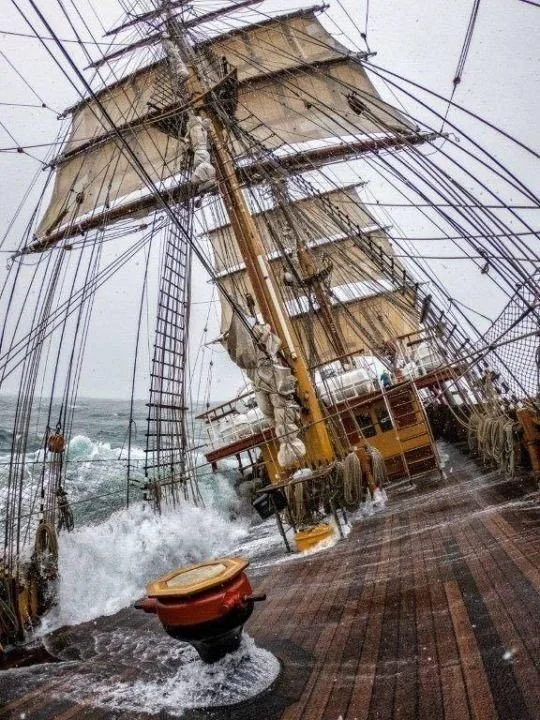
[Image: Ship in rough Seas]
Nicholas’ oldest child Mary literally married the “boy next door”, John Crew, Jr, whose family owned the land adjacent to her family’s homestead. There is no direct proof that his second daughter Susan married, but circumstantial evidence suggests she may have married William Exum, Jr. Except for the fact that she arrived in Virginia with her sisters no further documentation is available on his third child, Jane. Of his namesake, Nicholas Jr, their first child born in the New World, only a handful of records exist. His fifth child, Sarah most likely married Richard Bell, because a Sarah Bell was present at Nicholas Cobb, Sr’s bedside when he died. His youngest child, Edward, is my ancestor.
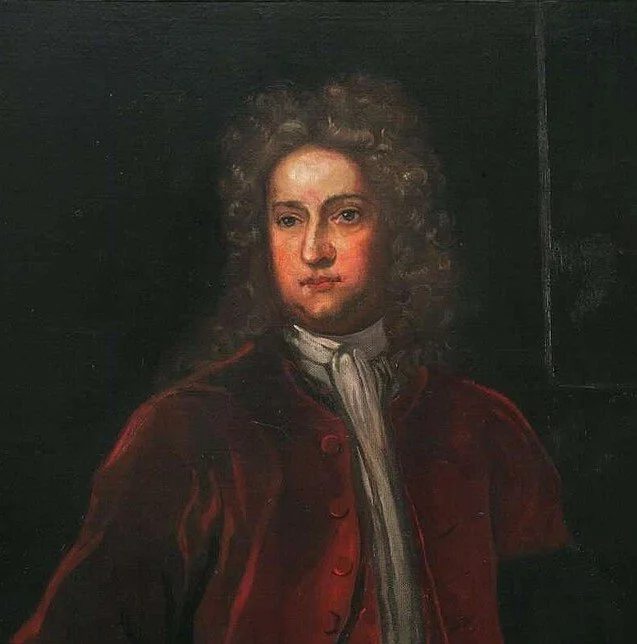
The seeds of the American Revolution against the British were present in Virginia from the early days of the colony. Settlers were furious at rising taxes, the low prices for tobacco, and the failure of the British colonial government to defend the frontier against attacks by Native Americans. They bridled at the special privileges that were handed out to the wealthy friends of the unpopular crown-appointed Governor Sir William Berkeley.
[Painting: Governor William Berkeley by Hariot Montague]
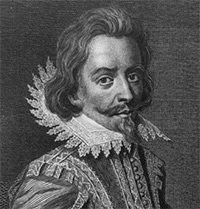
In 1676 a wealthy 29 year old planter named Nathan Bacon fomented a rebellion against Berkeley and the British colonial government headquartered in Jamestown, the capital of the Virginia Colony. Bacon took the Capital by force, ignited a fire that left Jamestown in ruins, but the rebellion floundered without his leadership when he suddenly died ignominiously of dysentery. The rebels surrendered in 1677 with a promise of amnesty, but 23 rebels were hanged anyway, and Bacon’s property was confiscated by the Crown. On the list of treasonous rebels pardoned was a man named William Blunt.
[Painting: Nathan Bacon]
Nicholas Sr died in his mid-70s sometime between October of 1684 and May of 1686 without a will. He recited his last wishes from his death bed to his friend William Blunt, the pardoned rebel from the Bacon uprising, whose written deposition follows:
“That being at the house of Mr. Nicholas Cobb that night he was taken sick and died being sent for by him, he decided to take notice of what he sayd. He sayd that he did give unto his sonne Nicholas twelve pounds; and he did give his son Edward his land and to the heirs of his body lawfully begotten and for want of such heirs to his daughter Mary and the heirs of her body lawfully gotten; and he did give to his daughter Sarah twelve pounds, and his person estate to his sonne Edward and his daughter Mary to be equally divided between them two and further sayeth not.”
Prior to his death, Nicholas transferred the 900 acre parcel of land to his son Nicholas Jr. Nicholas Jr died shortly thereafter in January of 1687, and the land passed to his brother, Edward. To continue following the Cobb family line, read the blog for Edward Cobb (1664-1731).
